Two purchases
What is the difference between hiring a vendor and using Belonging Games?
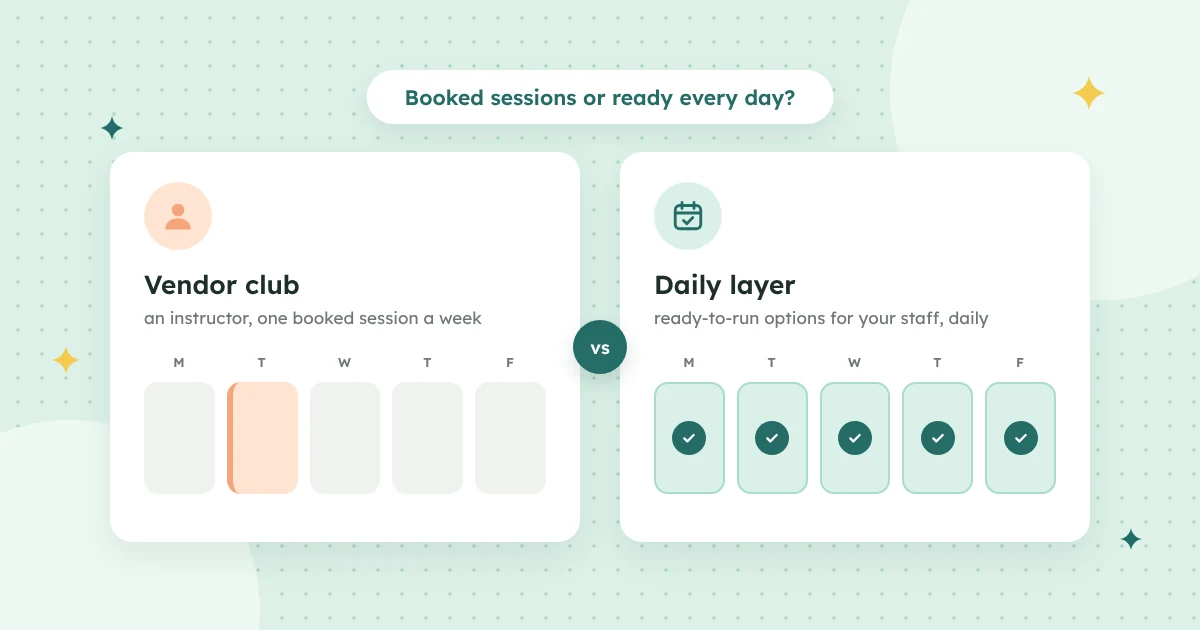
An enrichment vendor sends its own instructor to your site for a booked block. Mad Science, Play-Well TEKnologies, LIFT Enrichment and Bricks 4 Kidz work this way. Kodely does too, and can also operate a site's whole expanded learning program, which is outside this comparison. The instructor brings the materials and the expertise and teaches one subject in depth for a set number of weeks, while your staff supervise.
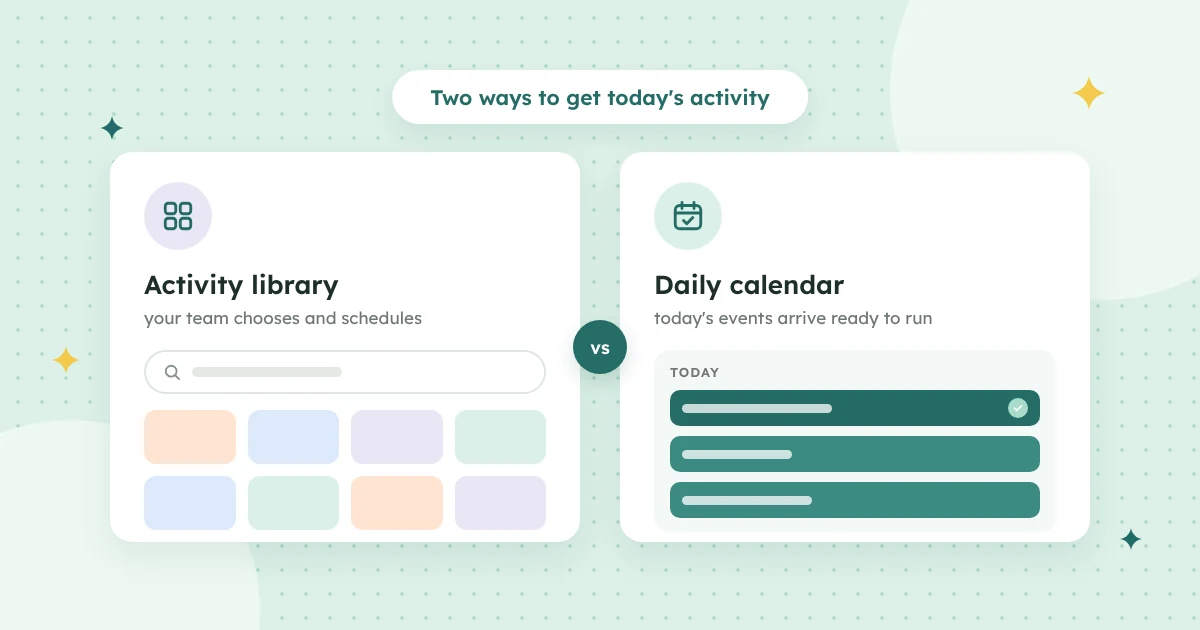
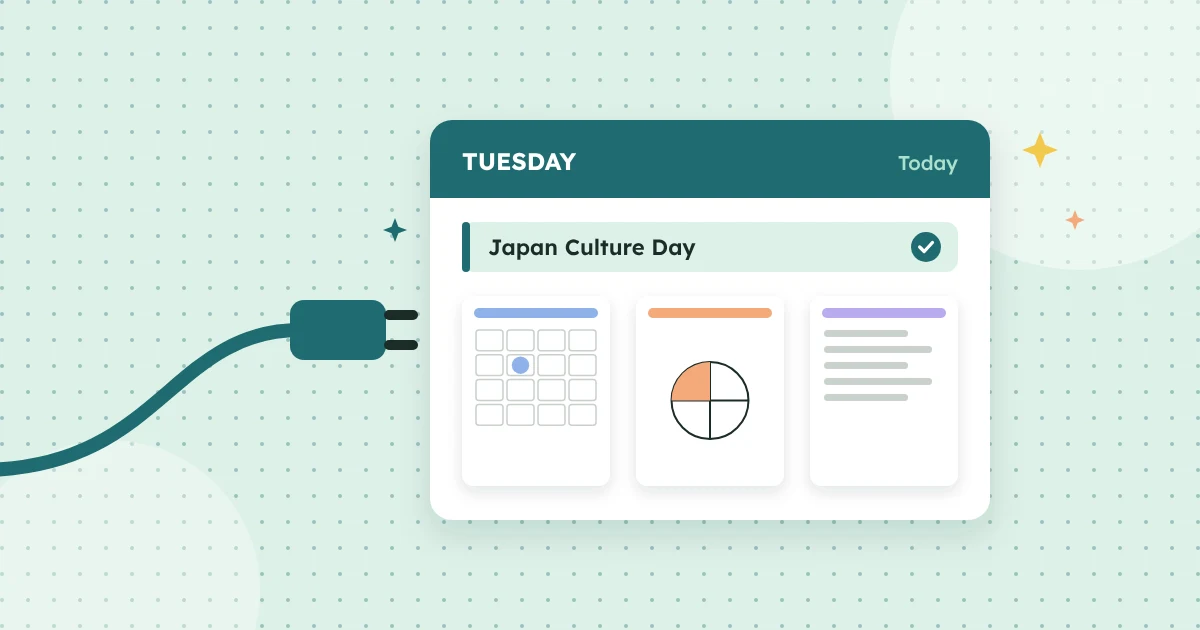
Belonging Games sends no one. Each day, 1–3 curated events arrive in your team's Google or Outlook Calendar, each with the same 12 ready-to-run files: an educator guide, 7 printable activities, 3 projector activities and a certificate. Your own educators choose one, print or project it, and lead.
A vendor sells an expert-led session. Belonging Games sells prepared activities your staff can run on any day. Our earlier guide, enrichment vendors and Belonging Games: two different jobs, explains why programs use both. This page is about the numbers and the terms.
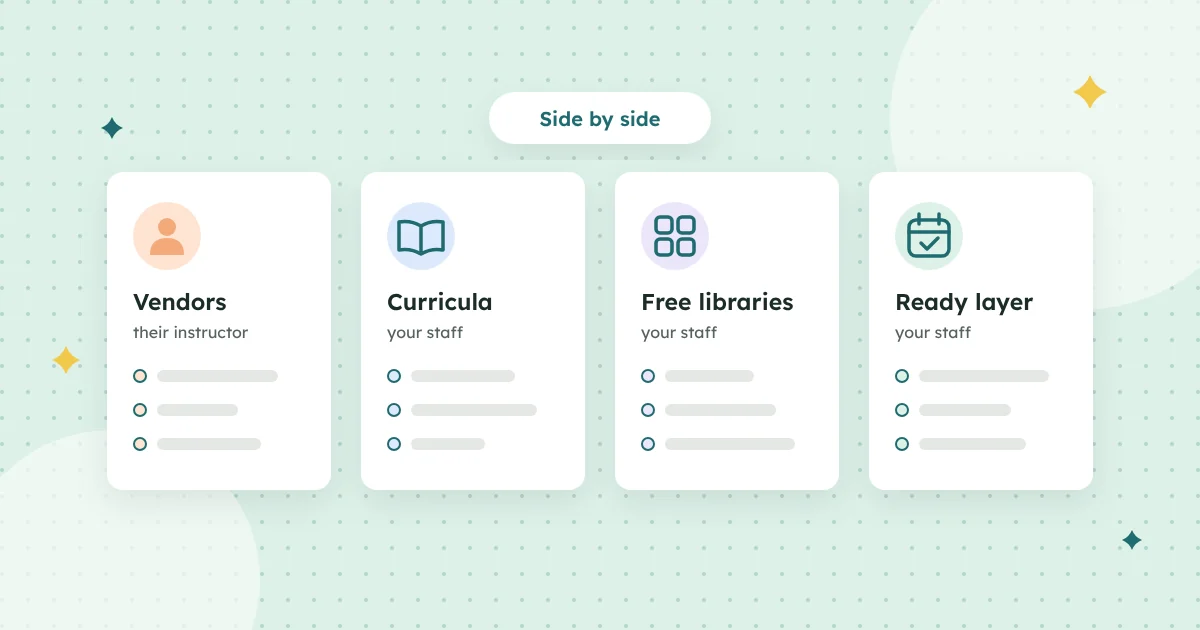
Side by side
How do a vendor and Belonging Games compare?
| Enrichment vendor | Belonging Games | |
|---|---|---|
| Who leads | The vendor's instructor | Your own staff |
| What children get | One subject in depth, hands-on, often with a take-home project | A new cultural, SEL or STEM theme each day, with games, facts, drawing and discussion |
| When it runs | A booked block, usually 60 to 90 minutes a week for 4 to 12 weeks | Whenever your staff run it; events arrive every day |
| Who takes part | The children enrolled in that club, often with a class size limit | Every child at the site, in mixed-age groups (K–5) |
| Your staff's part | Provide a room and supervise | Choose an event, print or project, and lead |
| How it is priced | Per child per program, or by proposal | Per site per year, flat |
| Published price | Mad Science: $72 per child for a six-week club at one franchise, from $165 at another, and from $109 at a third. Kodely, Play-Well, Bricks 4 Kidz and LIFT Enrichment: by quote | $3,650 per site per year; $600 for a 30-day pilot, credited to an annual license if you continue |
| Minimum enrollment | Often needed for a class to run | None |
| If a session does not run | Varies by provider and reason: a substitute, make-up session, refund, rescheduling or cancellation may apply | No outside instructor is required; a prepared alternative is available if a scheduled activity falls through |
Sources for each row are listed at the end. Prices and terms were checked on November 16, 2026.
Where a vendor wins
When is an enrichment vendor the better choice?
Hire a vendor if these matter most to you:
- You want specialist depth. A science instructor with real equipment, a LEGO engineering coach or a cooking teacher with a portable cooking kit can do things your staff cannot do from a printed page.
- You want a multi-week club that builds. Vendor programs run as a series, typically four to twelve weeks on one subject. Belonging Games events are single-day and do not build on each other.
- You want your staff free to supervise. The instructor leads; your team manages the room.
- Families will pay for it. Many vendor clubs are paid by parents through registration, so the club can cost the program little or nothing. Belonging Games is a license the program buys.
- You want a headline offer. A robotics or cooking club gives families something specific to sign up for.
Where Belonging Games wins
When is Belonging Games the better choice?
Choose Belonging Games if these describe your program:
- You need enrichment on more days than you can book. A weekly club delivers its own session. Your staff still need something worth running on the other days.
- You want every child included. A club serves the children enrolled in it. A site license covers every educator and every child at the site, with no per-student fee.
- You want something new for children every day. Each day brings a selection of cultural, historical, STEM and SEL themes. Some are tied to specific dates or celebrations; others are chosen to give children new things to discover and explore. Through a shared activity, children meet other cultures, try new ideas and connect with each other.
- You need a fixed cost. The price does not change with enrollment, and nothing depends on reaching a minimum.
- Your staff changes often. Every event follows the same 12-file structure, so new and substitute educators can quickly find what they need and get familiar with the format.
A vendor brings an expert for the sessions you book. A second layer gives your own staff something worth running on every other day.
Cost
What does each one cost for a year?
Vendors that publish prices charge per child. Two Mad Science franchises list a six-week, one-hour-a-week club: $72 at Greater Salt Lake, plus any facility fee the school charges, and from $165 at Long Island. Greater Tampa Bay lists programs of 4 to 12 weeks from $109. Most other vendors quote on request.
Illustration: one club, 20 children, one hour a week for 36 weeks, as six six-week cycles at an unchanged price. We use 20 because some vendors publish a limit of that size: LIFT Enrichment caps a workshop at 20 students, and Kodely staffs up to 20 students per instructor. The two Mad Science pages cited here do not state a class limit.
| Published price per child, six weeks | One cycle, 20 children | School year, six cycles | What it buys |
|---|---|---|---|
| $72 | $1,440 | $8,640 | 36 instructor-led hours for 20 children |
| $165 (starting price) | $3,300 | $19,800 | 36 instructor-led hours for 20 children |
These are illustrative calculations based on published franchise prices, not annual vendor quotes. Actual contracts, available sessions, group sizes and additional fees may differ.
Who pays matters. Mad Science's Salt Lake page says parents usually pay through registration, and a PTO may cover part or all. In that case the club costs your program very little. If your program pays from its own budget or grant, it carries the whole figure.
Belonging Games is $3,650 per site per year, for unlimited educators and children. For a site open 180 days, that is about $20 per program day. A 30-day pilot is $600, credited to the annual license if you continue. That is the license, not the whole cost of delivery: your staff still lead the activities, and you supply the printing and basic supplies such as paper and pencils.
The two prices are not like for like, and the lower one is not automatically the better buy. The vendor price buys an expert and materials for booked sessions. The license buys prepared activities your staff can run on any day. For more worked examples, see what after-school enrichment costs.
Coverage
How much does each one cover?
The two measure coverage in different units, so compare them with care.
- Vendor coverage is instructor-led sessions delivered to enrolled children. One weekly club for 36 weeks is 36 one-hour sessions. Two clubs on different weekdays are 72.
- Belonging Games coverage is days when ready-to-run options are available to your staff. For a site open 180 days, that is all 180, for every child at the site. An option only becomes a session when one of your educators runs it.
So a vendor schedule gives you a known number of expert-led hours. On the other 108 to 144 days of a 180-day year, the afternoon is filled by what your own team runs: curriculum, homework help, staff-led clubs, free play. Belonging Games adds a prepared option to each of those days.
Cancellations
What happens when a session does not run?
It depends on the vendor and on why. These are four different situations, and the public pages we reviewed cover them unevenly.
| Situation | What the pages we reviewed say |
|---|---|
| School closure or severe weather | Four Mad Science franchises (Long Island, Greater Tampa Bay, San Diego, Northeast Ohio) say they follow the school's closure policy and will try to schedule a make-up class, under conditions |
| An instructor is absent | Kodely says it arranges a cleared substitute and tells the site contact in advance when possible. Play-Well notes that the instructor may not be confirmed until shortly before the first class |
| Not enough children enroll | Del Mar Union School District, which hosts vendor classes, cancels a class that has not reached its minimum before families are charged |
| A same-day cancellation with no substitute | Not addressed on the pages we reviewed |
These terms are reasonable, and many vendors will have more detailed ones in their contracts. The practical point is that a make-up class or a refund settles the booking, but it happens on another day. If a session falls through with the children already in your room, the hour belongs to your staff. Before you sign, ask every vendor three questions: how much notice will we get, do you send a substitute, and what happens to the session we paid for?
One afternoon
What can the hour look like when a club is cancelled?
Programs with a well-kept backup plan handle this already. Here is how the same hour can run with Belonging Games, without sending anyone to the copier.
Take Tuesday, November 3, 2026. A program has 40 children in grades 1–5, two educators on the floor, staffing that meets its local supervision requirements, one room with a projector, and a science club booked from 4:30 to 5:30. At 2:10 the vendor emails: the instructor is out, and a make-up class will be scheduled.
| Time | What happens |
|---|---|
| 2:15 | The site coordinator opens today's calendar entry. Three events are there: Japan Culture Day, Micronesia Free Day and Panama Canal Day. She picks Japan Culture Day and opens its two projector activities, Facts and Trivia, on the room's computer. Nothing is printed |
| 3:15 | Arrival, snack and homework as usual. Children are told the plan has changed and what they are doing instead |
| 4:30 | Two groups of 20, one educator with each, within the pack's guidance of up to 30 children per group. Group one, in the projector room: the educator reads the guide's opener, goes through the Facts deck (free museum days, origami, haiku) and runs the 10-question Trivia game show. Group two, with paper and pencils: each child writes a haiku about today's weather, a task from the pack's Bingo card |
| 5:00 | The groups swap |
| 5:25 | Everyone together for the close from the guide, then pickup |
If there is time and a free adult, the printable Bingo cards and certificates can be added. They are not needed to fill the hour well.
See it for yourself: Explore Japan Culture Day, a complete enrichment pack with all 12 files available without an account. Or browse the live calendar to see what Belonging Games offers each day.
Together
Should a program have both?
Often, yes. A program can keep a science club on Tuesdays and a cooking club on Thursdays, and use Belonging Games on the other days and whenever a session ends early or does not run. Programs with strong routines of their own still gain something: an extra set of curated, meaningful activities each day that nobody on the team had to develop.
If your budget allows only one, decide by the question you most need answered. "Who can teach robotics here?" points to a vendor. "What can our own staff run today?" points to Belonging Games.
See also: Belonging Games vs Mizzen · After-school enrichment programs compared · When the after-school plan falls through · Book a demo
FAQ
Questions
What are alternatives to hiring outside enrichment vendors for an after-school program?
There are three: a curriculum or kit your staff teach, a free activity library your staff choose from, and a ready-to-run service such as Belonging Games, where 1–3 prepared events arrive in your calendar each day and your own staff lead them. None of these brings a specialist instructor, which is what a vendor is for.
Our enrichment vendor cancelled today. What can we do with 40 kids for an hour?
Hold the room with a routine the children know, then split into two groups and run one shared theme that needs no copier: a short opener, a set of facts and a trivia game on the projector for one group, a paper-and-pencil task for the other, then swap. With Belonging Games that set is already in the day's calendar. See when the after-school plan falls through for the first ten minutes.
Is Belonging Games cheaper than an enrichment vendor?
It depends on who pays and what you compare. A parent-paid vendor club can cost the program nothing. As an illustration, a program-paid club of 20 children at published Mad Science prices comes to about $8,640 to $19,800 a year for one instructor-led hour a week. Belonging Games is a $3,650 site license for activities your own staff lead, on any day, for every child.
Does Belonging Games replace our enrichment vendors?
No. It does not send instructors and does not teach one subject in depth. Programs keep the vendors that work and use Belonging Games on the days around them.
Can ELO-P or 21st CCLC funds pay for enrichment that does not need an outside vendor?
Both programs fund enrichment: California's ELO-P funds after-school and summer enrichment programs, and 21st CCLC supports centers that provide academic enrichment outside school hours. Whether a particular purchase is allowable depends on the grant, the approved program plan and local procurement rules. Do not assume any vendor or license is automatically eligible; confirm with your district or grant administrator before you buy.
Sources
Sources
- Mad Science Greater Salt Lake, After-school programs: $72 for six weeks plus facility fee, who pays, one-hour sessions (checked November 16, 2026)
- Mad Science Long Island, After-school programs: from $165 for six weeks, closure and make-up terms (checked November 16, 2026)
- Mad Science Greater Tampa Bay, After-school programs: from $109, 4 to 12 weeks, closure and make-up terms (checked November 16, 2026)
- Mad Science San Diego and Northeast Ohio: closure and make-up terms (checked November 16, 2026)
- Kodely, Expanded learning: enrichment partner and full-program models, 12-week courses, up to 20 students per staff member, proposal pricing, substitute policy (checked November 16, 2026)
- Play-Well TEKnologies, Hosting a program and About enrichment classes: per-student fees by quote, weekly format, instructor assignment (checked November 16, 2026)
- LIFT Enrichment, Services: 10-week cooking program, one-hour workshops for up to 20 students (checked November 16, 2026)
- Bricks 4 Kidz, After-school programs: program format, pricing by enquiry (checked November 16, 2026)
- Del Mar Union School District, Enrichment FAQ and Policies and procedures: minimum enrollment, class size (checked November 16, 2026)
- California Department of Education, Expanded Learning Opportunities Program FAQs: what ELO-P funds (checked November 16, 2026)
- U.S. Department of Education, Nita M. Lowey 21st Century Community Learning Centers: what 21st CCLC supports (checked November 16, 2026)
- Belonging Games pricing: price, pilot, what each event includes (checked November 16, 2026)
- Belonging Games, Japan Culture Day: the events on November 3, 2026 and the 12 files in the pack (checked November 16, 2026)