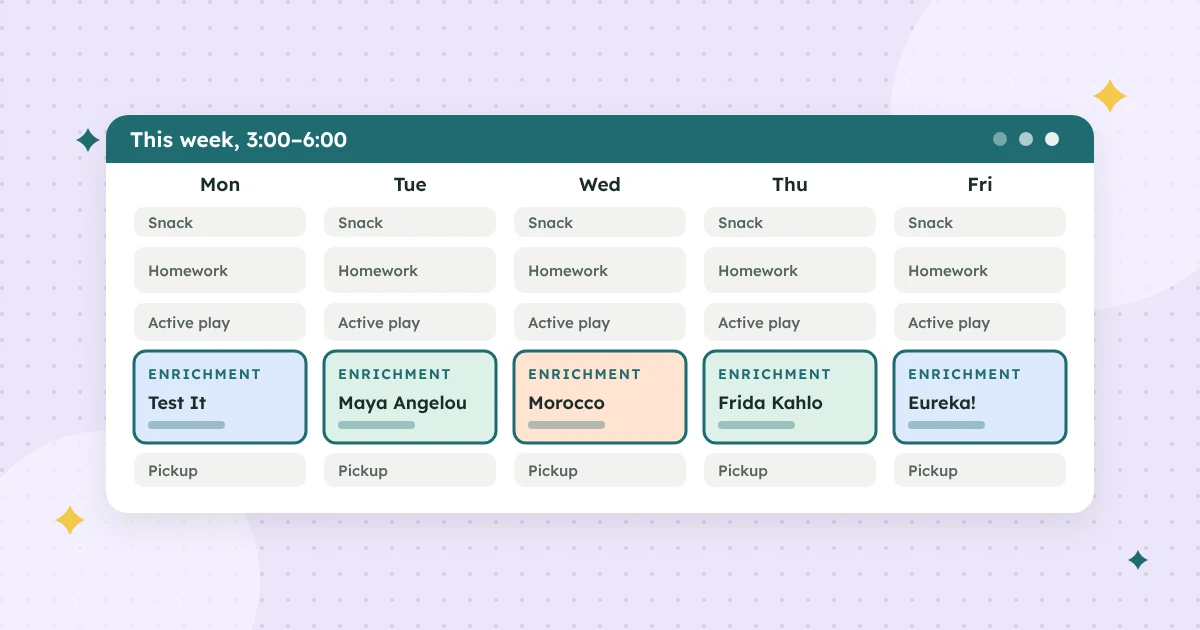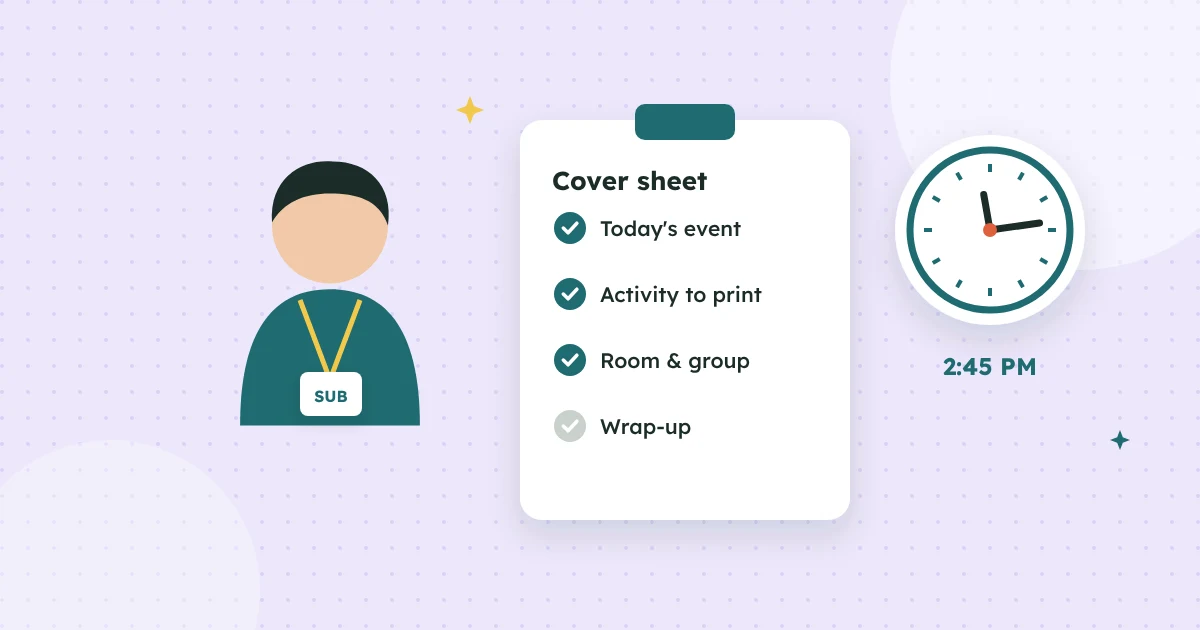
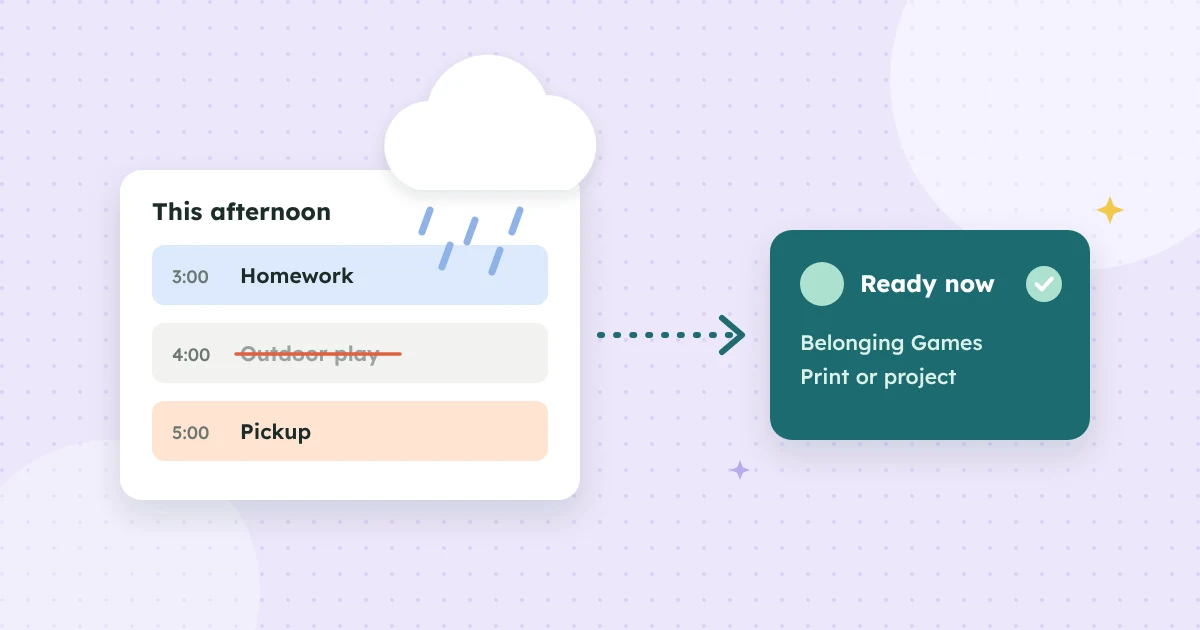
None of these are failures of planning. They are what an after-school afternoon is made of, and they happen in most programs most weeks. This page is about what to do when one of them happens, and then about why the question keeps coming back, and what a program can design so that it stops being answered at four in the afternoon.
Next ten minutes
The next ten minutes
1. Hold the room first.
Before you look for an activity, give the group something it already knows how to do: a circle, a quick game the children can start themselves, the standing routine your room uses for transitions. A room that is held buys you the minutes to decide. A room that is drifting does not.
2. Decide one thing, not three.
Do not compare options. Pick the first thing that needs nothing you do not have and that the person leading it can run on sight. The quality of the next half hour depends far more on starting than on choosing well.
3. Choose what needs nothing.
Paper, pencils, the projector if it is already on, and the people in the room. Anything that sends an adult to the closet or the copier is not the activity for this moment. Twelve activities that pass this test are on our no-prep ideas page.
4. Tell the children the truth.
"The plan changed, and here is what we are doing instead." Children handle a changed plan well. They handle a drifting adult badly. Naming the change is part of the enrichment, not a break from it.
5. Write down what happened.
Who was out, what ran short, what you did instead. Not for blame. For the pattern. The same gap will come back, and the next section is about that.
See twelve no-prep enrichment ideas.
Why it keeps happening
Why it keeps happening
Good planning does not remove variation; it removes the variation the planner can control. What remains comes from outside the plan: staffing changes, weather, attendance, transitions, activities that end early or run long, a vendor who does not show. Enrilo calls this operational unpredictability. It is not poor management. It is the normal operating condition of after-school, and it arrives even in well-run programs, because its sources are not the program's to control.
When no response has been designed for those moments, the response has to be assembled in real time. Staff search for something, improvise, stretch what was already running, or reach for whatever is nearest. Those responses are not always poor. The problem is that their quality depends entirely on the time, preparation, and judgment available in that moment, which are exactly the things a disrupted afternoon has least of. A program can be strong in its planned programming and still uneven in practice, because the moments between the planned pieces are left to be solved on the spot.
Read Designing After-School Enrichment for Operational Unpredictability.
Backup vs. layer
A backup drawer is not a second layer
Most programs have a backup: a drawer, a binder, a folder of rainy-day activities. It is better than nothing, and it is not what this page is recommending. The difference matters.
| Aspect | A backup drawer | A second layer |
|---|---|---|
| When it is chosen | After the plan fails, in the moment | In advance, before anyone knows which day will break |
| Who chooses | Whoever is standing nearest the drawer | Already decided for today; the staff member opens it |
| What quality depends on | Who is reaching in and what they find | The design of the layer, the same for every staff member |
| What it covers | A handful of days, then it runs out or repeats | Every day of the year |
| What it assumes | That the plan usually holds | That some part of the plan will not hold, without knowing which |
| How it feels to staff | Scrambling | Opening today |
A backup is reactive. A second layer is anticipatory. It assumes in advance that some part of the planned day will become unusable, even though no one knows which part or when, and it prepares a designed, ready response for that general certainty rather than a scramble for each particular case. That is the difference between having a backup and having an architecture.
Read The Second Layer of After-School Enrichment.
The requirements
What a second layer has to be
The second layer activates at exactly the moments when time, preparation, and the person who planned the day are least available. So its enrichment has to meet unusually strict requirements, stricter than the planned programming it stands behind.
- Already decided for today, so no one has to choose under pressure.
- Ready in about five minutes, with nothing to gather, build, or read at length.
- Runnable by the staff member who is actually there, including someone who did not plan it and has not met the group.
- Fitted to ordinary conditions: mixed ages, shifting attendance, whatever the room has.
- Meaningful, so the unplanned hour is not a lesser hour. Children do not experience a day as planned and unplanned; they experience an afternoon.
- Available every day, because no one knows which day will need it.
A program can build its own second layer, and some do. It means deciding an activity for every day in advance, checking each one against the staff most likely to be covering, keeping materials to what every room already has, and maintaining it across a whole year. The two-layer model holds whether a program builds that layer or licenses one. Plug-and-play enrichment is the delivery model Enrilo proposes for it.
Read the full definition of plug-and-play enrichment.
Belonging Games
Belonging Games is a second layer
Belonging Games, by Enrilo, is a daily, plug-and-play enrichment service for elementary after-school programs. Each day, educators receive 1–3 curated events across cultural, SEL, and STEM themes through their existing Google or Outlook calendar. Every event includes complete, ready-to-run activities (an educator guide, 7 printables, 3 projector activities, and a certificate) that their own staff can lead without planning or preparing from scratch. It gives staff something meaningful to run every afternoon, and the same events are there when the day changes: a staff call-out, a cancelled club, rain, homework finishing early.
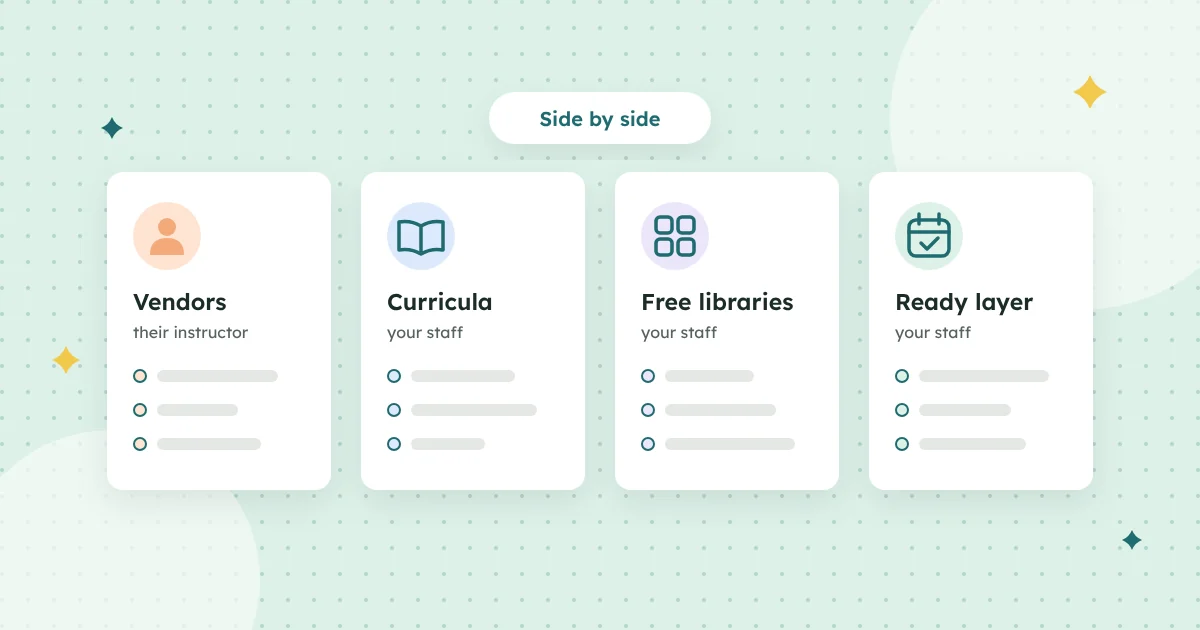
Most programs use Belonging Games every day, not only when something goes wrong, which is why it is ready on the day something does. When the plan falls through, the staff member opens today in the calendar. Today's 1–3 events are already there, each with 7 printables and 3 projector activities that all fit the day, and a short educator guide that reads in a minute. Nothing has to be gathered. The person covering can run it on sight. Your curriculum, clubs, and vendors remain Layer 1 and keep doing what they do well. Belonging Games is the daily layer around them, for the hours they cannot reach.
See how programs use Belonging Games alongside their vendors and clubs, and what substitute and new staff need to run it.
To see how much unplanned time your program carries in a year, try the Unpredictability Calculator.
FAQ
Questions
What should I do first when an after-school activity falls through?
Hold the room with something the group already knows, then decide one thing that needs nothing you do not have and that the person leading it can run on sight. Tell the children the plan changed and what is happening instead. Start. Choosing well matters far less than starting.
Why does the after-school plan fall through so often?
Because the sources of variation sit outside the plan: staffing, weather, attendance, transitions, activities that run long or short, vendors who cancel. Good planning removes the variation a planner can control. What remains is operational unpredictability, and it arrives in well-run programs too.
Is a rainy-day binder enough?
It helps, but it is a backup, not a second layer. A backup is chosen in the moment by whoever reaches for it, covers a handful of days, and depends on who finds what. A second layer is decided in advance for every day and is the same for every staff member.
What is a second layer of enrichment?
The part of a program's enrichment design built for the moments planned programming cannot proceed. Layer 1 is the plan: curriculum, clubs, vendors, specialists. Layer 2 is ready enrichment for everything the plan cannot cover. The two are complementary, and together they keep enrichment meaningful across the whole afternoon.
Can a program build its own second layer?
Yes. It means deciding an activity for every day in advance, checking each against the staff most likely to be covering, limiting materials to what every room has, and maintaining it all year. Programs that do not have the time to build and maintain it license one. Belonging Games is one implementation.
How does Belonging Games work on the day the plan breaks?
Every day already has 1–3 curated cultural, SEL, or STEM events in the team's Google or Outlook calendar, each with 7 printables, 3 projector activities, and a short educator guide. The staff member opens today, picks the event that fits the group, prints or projects it, and runs it. No searching, no choosing from a library, no materials to gather, no outside instructor.