Three shapes
What are the three ways after-school programs pay for enrichment?
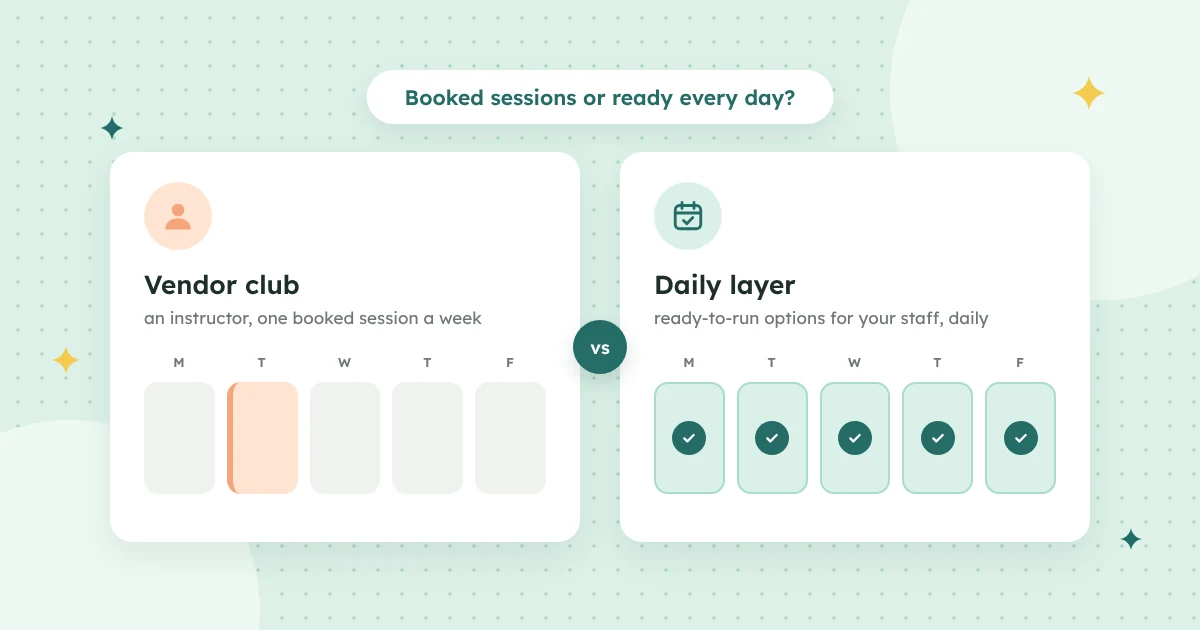
| Aspect | Outside-instructor vendor | Curriculum license or kit | Ready layer |
|---|---|---|---|
| Who leads | The vendor's instructor | Your staff, after planning | Whoever is on the floor, no planning |
| What you pay for | One club, one hour a week, for a set number of weeks | The content, for a year or for good | 1–3 curated events every day, ready to print or project, in the staff calendar |
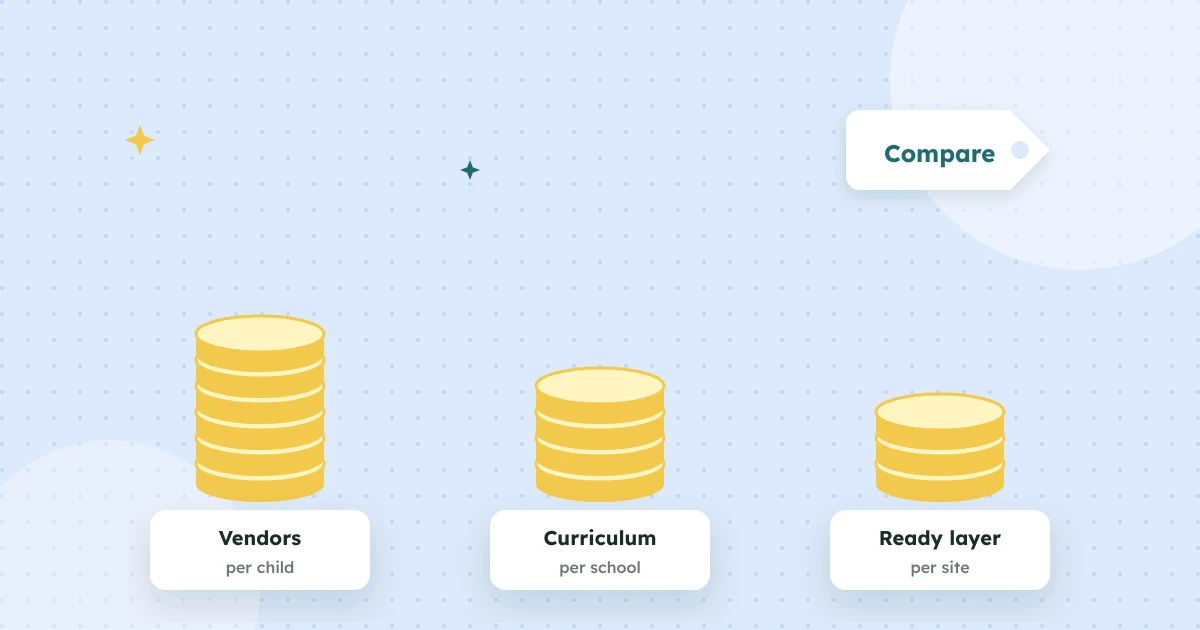
| Published example | $72 per child per 6-week club (Mad Science) | $652 one-time OST kit; $2,595 and up per year schoolwide digital (Second Step) | $3,650 per site per year (Belonging Games) |
| Scales with | Number of children enrolled | Number of schools | Number of sites |
| Covers | The scheduled hour | The lessons staff get to | Every day, including the ones that do not go to plan |
Vendors
What does an outside-instructor vendor cost for a year?
Vendors price per child per session because they are selling an instructor's time. Mad Science's published rate is $72 per child for a six-week club that runs one hour a week, plus any facility fee the school charges. That is $12 per child per hour.
Worked example: 30 children, one hour a week, 36 weeks.
- One six-week cycle: 30 children × $72 = $2,160
- A school year is six cycles: 6 × $2,160 = $12,960
- What that covers: one hour a week, or 36 hours in the year
Two things to notice. Mad Science's own page says parents usually pay through registration; when a program pays with ELO-P or 21st CCLC money, the program carries the whole figure. And the price covers the scheduled hour only. The other four afternoons, the rainy day, and the week the instructor cancels are not in it.
Curriculum
What does a curriculum license cost, and what is not in the price?
A curriculum license sells content, not delivery. Second Step lists its Out-of-School Time kit at $652 as a one-time purchase and its Elementary and Middle School digital license at $2,595 to $15,372 depending on whether you buy one, three, or five years, with one price for the whole school regardless of how many grades use it.
What is not in the price: the staff hours to read, plan, print, and lead each lesson; training; and what happens on the day the person who planned the lesson is out. A curriculum is Layer 1, the plan. Good programs need one. The cost question is whether anything covers the days the plan does not reach.
Ready layer
What does a ready layer cost?
Belonging Games is $3,650 per site per year, flat. The site license covers every educator and every student at that site. Every day of the year, including breaks and weekends, 1–3 curated events arrive in the calendar your staff already use, each with an educator guide, 7 printables, 3 projector activities, and a certificate. There is no planning, no prep, and no outside instructor. On a 365-day year that is $10 a day.
A 30-day pilot at one site is $600, and the full $600 is applied to the first annual license if you continue. Invoices and purchase orders are accepted. See pricing for details.
Per covered day
How do the three compare per covered day?
The honest comparison is not price against price. It is what a dollar buys and when it is there.
- Vendor, worked example above: $12,960 for 36 covered hours, or $360 for each hour a group of 30 is covered.
- Curriculum license: $652 to $2,595 and up, divided by however many lessons staff actually get to run. The price does not change with use; the coverage does.
- Ready layer: $3,650 for 365 covered days, or $10 a day, whoever is on the floor.
None of these replaces the others. A vendor gives children an expert hour. A curriculum gives staff a plan. A ready layer gives staff something meaningful to run every other afternoon, and it still holds when the plan falls through.
Budget
Which one should an ELO-P or 21st CCLC program budget for?
Strong programs are built in two layers. The first is the plan: staffing, schedule, and the vendors or curriculum you chose in advance. Funding was designed to buy that layer, and it is what gets audited. The second is the enrichment your own staff run every day, around and between the plan, including the moments that do not go as planned: a staff call-out, rain, a club that finishes early, a substitute who has never met the group. Most programs budget for the first layer and improvise the second. The budget question is not which type to pick. It is whether the second layer exists at all.
Related: Enrichment vendors and Belonging Games: two different jobs · ELO-P enrichment · 21st CCLC enrichment
FAQ
Questions about cost
How much does Belonging Games cost?
$3,650 per site per year, covering every educator and student at the site. That is $10 a day for a year of ready-to-run enrichment.
Is there a free trial?
No. There is a 30-day pilot at one site for $600, and the full $600 is credited to the first annual license if you continue.
Can ELO-P or 21st CCLC funds pay for it?
Programs funded by ELO-P and 21st CCLC use Belonging Games as enrichment programming. The license is one annual invoice, and purchase orders are accepted. Confirm the budget category with your district or grant manager as you would for any enrichment purchase.
Does the price change with the number of children or staff?
No. One site license covers everyone at the site. Add sites, not seats.
A vendor's per-child price looks cheaper. Is it?
Per child per hour, yes. Per year, a 30-child club at the published rate is about $12,960 and covers one hour a week. The ready layer is $3,650 and covers every day. They are different purchases; the question is which days you need covered.
Do we still need vendors or a curriculum if we buy the ready layer?
Keep what works. The ready layer does not replace the plan; it covers the afternoons the plan does not reach, every day.
Sources
Sources
- Mad Science Greater Salt Lake, After-School Programs (checked October 2, 2026)
- KiwiCo Tinker, Program offerings (checked October 2, 2026)
- Second Step, Elementary products (checked October 2, 2026)
- Second Step, Elementary and Middle School Digital Programs (checked October 2, 2026)
- Belonging Games pricing (checked October 2, 2026)