Right now
Need something to run right now?
Pick the row that matches your room.
| What you have | Activity | How to start |
|---|---|---|
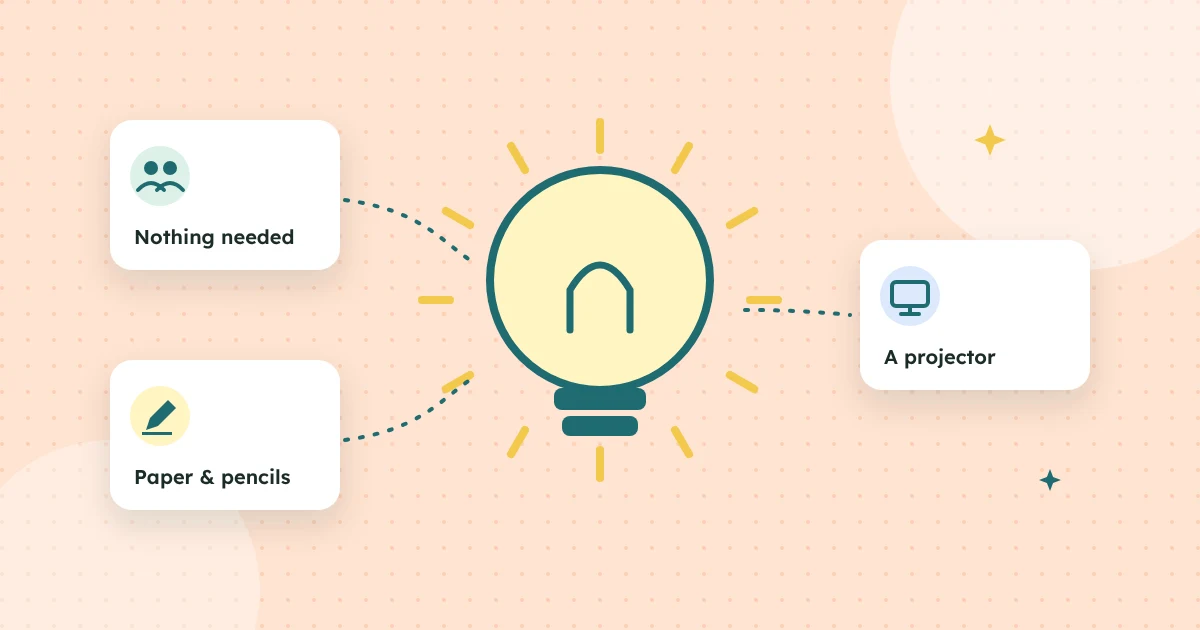
| Nothing but the room | Count to twenty | The group counts aloud from one to twenty, one voice at a time, with no set order and no signals. If two children speak at once, start over. Afterward, ask what finally made it work. |
| Paper, pencils and two books | Paper bridge | Each child gets one sheet of paper. The bridge has to span the gap between two books and hold as many pencils as possible. Let them test, fold and try again. |
| A screen, internet access and a GoNoodle account already set up | A short movement video | Open a video you have picked before and have the group follow along. GoNoodle videos run from 1 to 20 minutes. |
The first two come from our guide to twelve no-prep enrichment ideas, which has ten more. The rest of this page is for choosing where your activities come from on the other days.
Definition
What counts as no-prep, and how ready is each option?
A no-prep activity is one a staff member can start with the children, the time and the materials already in the room. Nothing has to be planned, bought or built first. No activity is free of all work: someone still chooses it, and an adult still leads it and reads the group.
Most resources that call themselves no-prep need something first: a choice, a login, a printer, a screen, a kit or supplies. So this guide sorts every option into one of three levels.
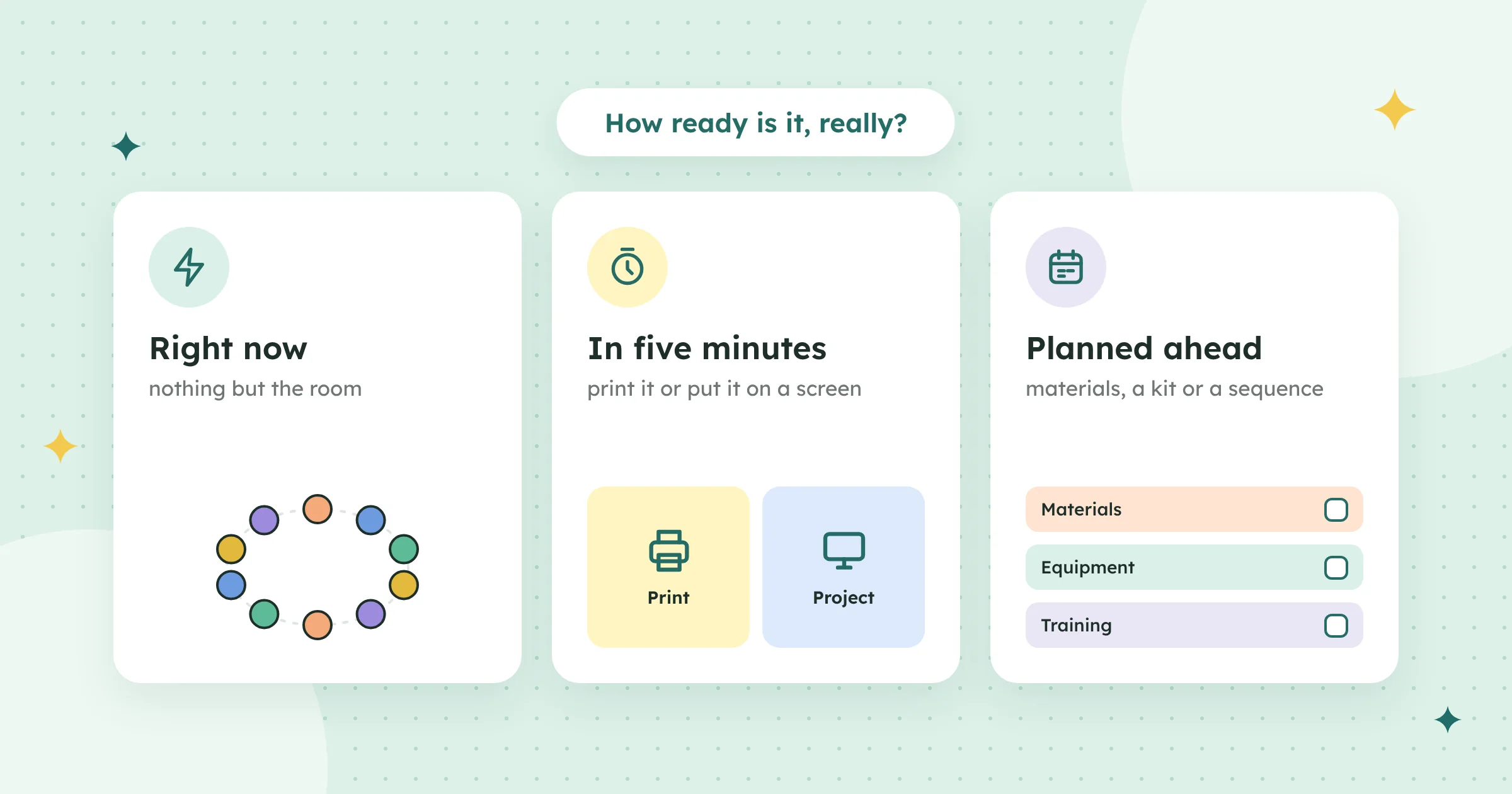
| Level | What it means | Examples |
|---|---|---|
| No-prep now | It can start immediately with what is already in the room | A circle game your staff know; a Playworks game chosen earlier that needs no equipment |
| Ready in about five minutes | It needs one quick step first: a choice, a file to open, a page to print or a screen to start | Belonging Games, once the site is set up; GoNoodle, with the account and screen ready |
| Low-prep or planned | It needs equipment, materials, training or a sequence set up in advance | Science Buddies experiments; SPARK lessons; Second Step kits |
These levels describe the kind of step each option needs. We did not time them, and an activity can move up a level when a site already has things ready: a printed stack in a drawer, a game the whole team has played, a kit on the shelf. The five-minute mark comes from the readiness test in our no-prep ideas guide.
Side by side
How do the nine options compare?
| Option | What children do | What has to be ready first | Readiness | Grades or ages, as published | Published price |
|---|---|---|---|---|---|
| A game your staff already know | Cooperate, estimate, share, build with paper | Nothing; someone remembers it or picks from a short list | No-prep now | K–5 | Free |
| Playworks Game Library | Play active and cooperative games | A game chosen from the library; filters cover age, group size, time and equipment, including "None" | No-prep now for a game you already know that needs no equipment; about five minutes if you have to search | Pre-K to grade 6 and up | Free |
| GoNoodle | Follow short movement videos of 1 to 20 minutes | A free account, internet and a screen everyone can see | Ready in about five minutes | Designed for K–5 classrooms | Free |
| Crayola free coloring pages | Color at their own pace | Pages chosen and printed, and crayons or colored pencils on hand | Ready in about five minutes | All ages | Free |
| Mizzen | Arts, STEM, health and other activities, depending on what you pick | A free account and an activity or playlist chosen from the library; what each activity needs varies | About five minutes for an activity chosen ahead that needs no materials; otherwise planned | K–12 | Free |
| Science Buddies STEM Activities | Hands-on science and engineering | An activity chosen and its materials gathered | Low-prep or planned | Filters from kindergarten up | Free online resources; printing and distribution are subject to Science Buddies' usage terms |
| SPARK After School | Active games and movement skills | A subscription, and the equipment and set-up each lesson lists | Low-prep or planned | Ages 5–14 | $199 for one year of digital access; a free trial has limited access |
| Second Step Out-of-School Time | Social-emotional activities of about 20 minutes | The kit, and the online training that is part of the program | Low-prep or planned | K–5 | $652 per kit |
| Belonging Games | Read facts together, do Bingo missions, solve puzzles, draw, answer trivia | A site license, staff emails authorized, and a printer or a screen. Then an educator chooses one of the day's 1–3 events | Ready in about five minutes, once the site is set up | K–5 | $3,650 per site per year; $600 for a 30-day pilot |
These prices are not directly comparable. One is a kit you keep, one is a yearly subscription to a physical-activity curriculum, and one is a per-site license for daily content. Sources for each row are listed at the end.
By situation
Which option fits which situation?
Start from the time you have and what is already working in the room.
| Your situation | What you have | Best fit | Why | Also consider |
|---|---|---|---|---|
| A ten-minute gap, right now | Nothing in your hands | A game your staff already know | It is the only option with no step before it | A Playworks game you chose earlier that needs no equipment |
| Rain, the gym is taken, and children need to move | A room and a few minutes to look | Playworks indoor games | The library has an indoor category and sorts games by group size | GoNoodle, if a screen is on; SPARK After School, if your program owns it |
| A few children finished homework early | Crayons, and a printer or pages printed earlier | Printable pages | Quiet and individual, so the rest of the room can keep working | The printables left from the day's Belonging Games pack |
| A substitute or a new staff member is leading | Access set up before today | Belonging Games | The day's choice is already narrowed to 1–3 events, and each has an educator guide | A Mizzen playlist the coordinator printed ahead; a Second Step activity |
| Hands-on science this week | A day to gather materials | Science Buddies | Hundreds of activities, with materials the site describes as easy to find | Plan it the day before |
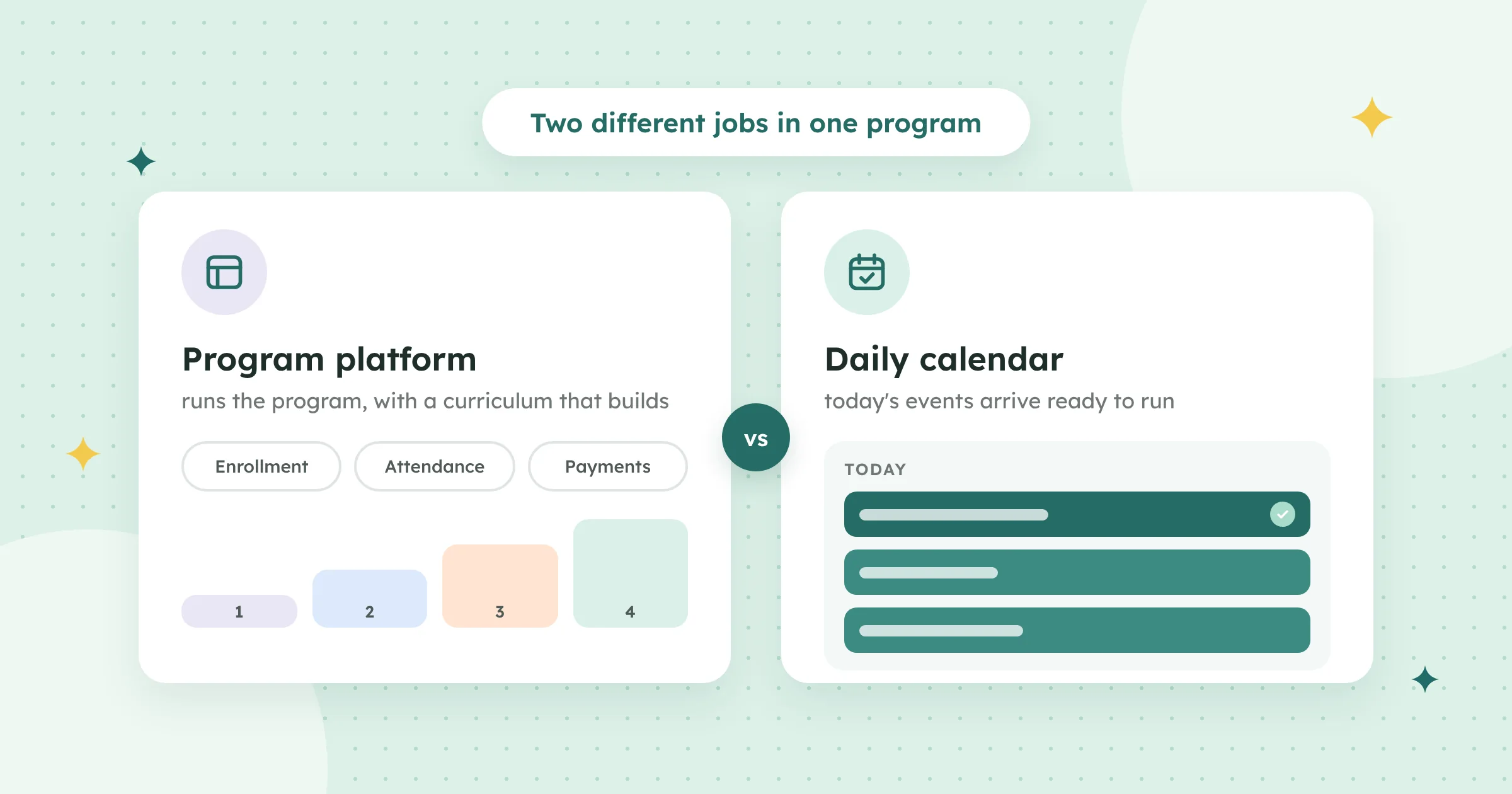
| Children should build one skill over several weeks | A budget, and time to learn the program | Second Step Out-of-School Time for social-emotional skills; SPARK After School for physical activity | A structured program is the point, and a daily service does not give you one | After-school enrichment programs compared |
| Something new and worthwhile every afternoon, and nobody is free to plan it | A budget for content, and a printer or a projector | Belonging Games | The daily selection and the activity materials are already done | Mizzen, if someone on your team has time to choose and schedule ahead |
A program that needs a ten-minute activity right now and a program that needs worthwhile enrichment every day have two different problems. The first is solved by a short list of games. The second is a question of who does the choosing and the preparing, every day, and when.
One by one
What does each option do well?
- A game your staff already know. Nothing is faster. Its limit is that the list lives in the heads of your experienced staff, so write it down for the substitute.
- Playworks Game Library. Hundreds of free games for groups, and each game page gives the set-up, how to play and variations. A game you have already chosen starts at once; searching the library takes extra time.
- GoNoodle. Children follow along, so the adult does not have to know the moves. Its sign-up is written for classrooms and families, so check its terms for your program.
- Crayola free coloring pages. Calm, creative time for any age with nothing to explain, as long as crayons or colored pencils are on hand. With an adult asking about what children are drawing, it can open a conversation too.
- Mizzen. More than 1,800 free ready-to-use resources for K–12, many made with partner organizations, plus playlists and planning tools for building longer plans. Someone on your team does the choosing. See Belonging Games vs Mizzen.
- Science Buddies STEM Activities. Real hands-on science; the site says most activities take an hour or less. Gather the materials for the whole group ahead of time, and read its terms before printing for a whole program.
- SPARK After School. A complete program focused primarily on physical activity: more than 700 activities in 25 units, written for youth leaders with no experience required.
- Second Step Out-of-School Time. A structured program for social-emotional skills in short activities. The publisher describes it as flexible, adaptable and low-prep, for facilitators at any experience level.
- Belonging Games. A different cultural, SEL or STEM theme every day, already chosen and already prepared, in the Google or Outlook Calendar your team uses. It is not free, it is written for K–5, and it is not a sequenced curriculum.
An afternoon
What can one afternoon look like with three of them?
These options are not rivals in a real program. An ordinary Friday can use three.
| Time | What is happening | What fits |
|---|---|---|
| 3:15 | Children arrive in waves, and the group is not complete yet | A circle game the staff know, with nothing to hand out |
| 3:30 | Snack and homework | Nothing needed |
| 4:15 | Enrichment block, 40 minutes | One of the day's Belonging Games events, printed during homework |
| 5:00 | Rain, so no outdoor time | A no-equipment indoor game from Playworks that the team chose earlier in the week |
| 5:20 | Pick-up, and the group gets smaller | Coloring pages, or the puzzles left from the day's pack |
On Friday, November 20, 2026, one of the day's Belonging Games events was Kids' Rights Day, for World Children's Day. The group reads a sheet of 15 facts together, then plays Bingo, where every square is a small mission. One asks a child to let a classmate take the first turn in the next game and say "you start." Another asks them to find out which right a classmate thinks matters most, and to listen to why. The other printables in the pack range from a coloring page to a cipher, so children of different ages can work on different pages.
Belonging Games
Where does Belonging Games fit, and where does it not?
What Belonging Games is. Belonging Games is a daily, plug-and-play enrichment service for elementary after-school programs. Each day, educators receive 1–3 curated events across cultural, SEL and STEM themes through their existing Google or Outlook Calendar. Every event includes complete, ready-to-run activities their own staff can lead without planning or preparing from scratch. An Enrilo product.
Every event has the same 12 files: an educator guide, 7 printable activities, 3 projector activities and a certificate. What Belonging Games takes off your staff is the daily selection and the development of the activities. It does not remove every step. A site needs a license, a one-time setup in which staff emails are authorized and each educator subscribes to the site's calendar, and a printer or a screen. On the day, an educator still chooses the event, prints or projects, sets up the room and leads, and still reads the group and supervises as for any activity.
It fits a program that wants enrichment to be a regular part of every afternoon, beside its curriculum, clubs and vendors, with the same prepared materials ready on the days a plan changes. It does not fit a moment with no printer and no screen, a program with no budget for content, a program that needs a skill taught in sequence, or grades above 5. Belonging Games does not currently publish formal studies of student outcomes.
See it for yourself: Explore Japan Culture Day, a complete enrichment pack with all 12 files available without an account. Or browse the live calendar to see what Belonging Games offers each day.
FAQ
Questions
What activities can new or untrained after-school staff lead with no preparation?
Activities where the choice is already made and the instructions fit on one page. A circle game a colleague has shown them works for ten minutes. For a full enrichment block, a prepared activity with a short guide, such as a Belonging Games event, a Second Step activity or a Mizzen activity the coordinator chose ahead, asks less of a new staff member than a library they have to search. See enrichment for substitute and new staff.
What can a substitute run in an after-school program?
Something that does not depend on last week, needs no login the substitute lacks, and can start with what is in the room or be printed or projected. A no-equipment game the team already uses covers a short gap. A Belonging Games event covers a longer block, because each event stands alone and comes with its own guide; the substitute's email has to be authorized first.
What are good low-prep printable activities for mixed-age K–5 groups?
Pages that children of different ages can do side by side. Free coloring pages work for any age. A Belonging Games pack has seven different printables on one theme, so a younger child can color while an older one works on the word search or the cipher.
What can you do on a rainy day with no prep?
Start with movement: an indoor game your staff know, a no-equipment game from the Playworks Game Library, or a GoNoodle video if a screen is on. Then move to a seated activity, such as one of the three at the top of this page or the day's Belonging Games event.
Is there a free option that covers every afternoon?
Yes, if someone on your team has time to choose and schedule the activities. Mizzen is free and has playlists and planning tools for that, and Playworks, GoNoodle, Crayola and Science Buddies add games, movement, coloring and science. What the free options do not do is make each day's choice for you.
Is Belonging Games really no-prep?
By the levels in this guide it is "ready in about five minutes, once the site is set up", not "no-prep now". There are no activities to plan or develop and no special activity kits to assemble. Your site still needs a license and its usual printing or display equipment. Educators choose an event, print or project the materials, set up the room and lead.
Sources
Sources
- Playworks Game Library and a sample game page, Chair Aerobics: hundreds of games, filters including equipment "None", what a game page contains; both pages opened without signing in (checked November 26, 2026)
- GoNoodle, About GoNoodle: K–5 classrooms, video length, internet and screen needed (page last updated January 9, 2021; checked November 26, 2026)
- GoNoodle, Create an account and What is new with GoNoodle: free account for a classroom or family, set up by an adult (checked November 26, 2026)
- Crayola, free printable coloring pages FAQ and Crayola free coloring pages: free to download and print (checked November 26, 2026)
- Mizzen, homepage and public playlists: 1,800+ free resources, K–12, nonprofit, playlists (checked November 26, 2026); content areas, planning tools and the free account are from our Mizzen comparison, checked November 16, 2026
- Science Buddies, STEM Activities for Kids: number of activities, grade filters, materials and time; the page allows printing and distributing up to 200 copies a year for personal and classroom educational use; for other uses, contact Science Buddies (checked November 26, 2026)
- SPARK After School: prices, 25 units and 700+ activities, ages 5–14, lesson format (checked November 26, 2026)
- Second Step Out-of-School Time, program page and store: K–5, about 20 minutes per activity, flexible and low-prep, online training, $652 per kit (checked November 26, 2026)
- Belonging Games pricing: price, pilot, what each event includes, calendar delivery, sign-in (checked November 26, 2026)
- No-prep enrichment ideas: Count to twenty, Paper bridge and the five-minute readiness test
- Belonging Games, Kids' Rights Day activity pack (November 20, 2026): the 15 facts sheet, the two Bingo missions described and the list of printables, read from the pack files