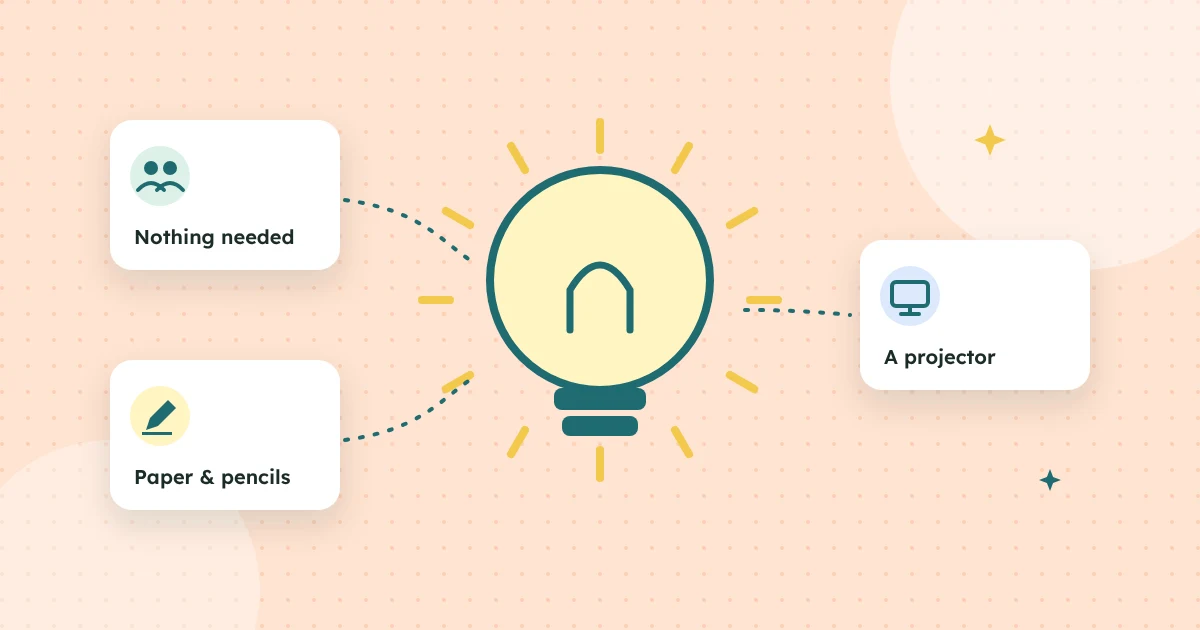
They are sorted by what you have on hand. Pick the group that matches your room.
The test
The five-minute test
Before any activity makes this list, it has to pass one question: can a realistic staff member, including someone new or covering, be ready to run it well in about five minutes? Printing a page or switching on a projector fits inside that budget. Choosing from a menu, gathering or buying materials, building stations, or reading a long plan breaks it. The clock does not count the activity itself, only what has to happen before it can start. Enrilo, the company behind Belonging Games, published the full rule as The Five-Minute Rule.
Nothing but the room
Four ideas that need nothing but the room
1. Count to twenty (SEL, cooperation)
The group tries to count from one to twenty out loud, one voice at a time, with no set order and no signals. If two people speak at once, start over. It takes a few tries, and the group learns to listen and leave space. Afterward, ask what finally made it work. Ten to fifteen minutes, any group size.
2. Silent line-up (SEL, communication)
Ask the group to line up by birthday, or by the number of letters in their first name, without speaking. They have to find other ways to communicate. Check the order at the end and let them fix it. Then ask what was hardest about not talking. Ten minutes.
3. Where my name comes from (cultural, identity)
Go around the circle and let each child share anything they know about their name: who chose it, what it means, where it comes from, or a nickname and how it started. Staff go first, which sets the tone. Children who do not know are invited to ask at home and report back tomorrow. Fifteen minutes, works best in groups of twelve or fewer.
4. Estimate, then check (STEM, measurement)
Ask everyone to estimate how many of their own steps it takes to cross the room. Write the guesses on the board or just say them aloud. Then each child paces it and reports. Talk about why the numbers differ: step length, counting, where they started. Try a second distance and see whether estimates improve. Fifteen minutes.
Paper and pencils
Four ideas that need paper and pencils
5. Paper bridge (STEM, engineering)
Each child gets one sheet of paper. The bridge has to span the gap between two books and hold as many pencils as possible. A flat sheet holds almost nothing; folding it changes everything. Let them test, fail, and refold. End by asking which fold worked best and why. Twenty minutes.
6. Design a flag (cultural, symbols)
Explain that flags use colors and shapes to stand for things people care about. Each child designs a flag for their family, their table group, or the program, then explains the meaning of three things on it. Hang them up. Twenty to thirty minutes.
7. Compliment chain (SEL, kindness)
Each child writes one specific compliment for the person on their left: something they did or said, not something they own or wear. Pass the papers and read them aloud, or let each child read their own. Specific is the rule, and staff model it first. Fifteen minutes.
8. One change (STEM, fair testing)
Everyone folds the same simple paper airplane and throws it from the same line. Then each child changes exactly one thing, a fold, a crease, a bent wing tip, and throws again. Did it go farther or shorter? Why one change? Because if you change two things you cannot tell which one mattered. That is the whole idea of a fair test. Twenty minutes.
Projector
Four ideas that need a projector
9. Map our roots (cultural, geography)
Project a world map. Children come up and point to a place their family comes from, a place they have visited, a place a favorite food comes from, or a place they want to go. Staff add theirs. Keep a tally of how many countries the room touches. Fifteen minutes, and it changes how children see each other.
10. One photo, twenty questions (STEM, observation)
Project one striking photograph: a market, a bridge, a volcano, a street in a city none of them have seen. Children ask only yes-or-no questions to work out where it is and what is happening. Staff answer only what can be seen in the picture. The skill is looking closely before guessing. Fifteen minutes.
11. Feelings check-in (SEL, self-awareness)
Project a simple four-square grid: high energy and pleasant, high energy and unpleasant, low energy and pleasant, low energy and unpleasant. Each child points to or names the square they are in right now. No explaining required. Then ask the group for one thing that helps move from an unpleasant square to a pleasant one. Ten minutes, good at the start of the afternoon.
12. Draw what I describe (SEL, listening)
Project a simple drawing that only the staff member can see on their own screen, or hold a printed one. Describe it one line at a time while children draw what they hear. Reveal the original and compare. Then let a child describe the next one. The lesson is how much depends on clear words and careful listening. Fifteen minutes.
The catch
Why a list of ideas is not a system
Every idea above passes the five-minute test on the day you use it. The problem is the day after that, and the hundred and seventy days after that. A list runs out. Once it does, the staff member is back to searching, choosing, and improvising, usually at four in the afternoon, usually on the day the plan already fell through.
Choosing is the work. Once a staff member has to pick today's activity from a list, the clock on readiness has not started yet. The five-minute rule assumes today's activity is already decided. A list, however good, leaves that decision on the floor, and that is what turns enrichment into filler on an ordinary Tuesday: not a lack of ideas, but a lack of a ready answer to "what are we doing right now?"
That is the difference between an activity resource and a plug-and-play enrichment layer. A resource gives staff options. A layer gives them today, already curated, already printable or projector-ready, with a short educator guide, so the only work left is running it.
Read the full definition of plug-and-play enrichment.
If the person running it is new or covering, read enrichment for substitute and new staff.
Belonging Games
Every day, already curated
Belonging Games, by Enrilo, is a daily, plug-and-play enrichment service for elementary after-school programs. Each day, educators receive 1–3 curated events across cultural, SEL, and STEM themes through their existing Google or Outlook calendar. Every event includes complete, ready-to-run activities (an educator guide, 7 printables, 3 projector activities, and a certificate) that their own staff can lead without planning or preparing from scratch. It gives staff something meaningful to run every afternoon, and the same events are there when the day changes: a staff call-out, a cancelled club, rain, homework finishing early.
Each day brings 1–3 curated events, each with 7 printables and 3 projector activities, so the staff member chooses from a handful of things that all fit today, not from a library of thousands. Use the twelve ideas on this page freely. When you want the other 170 days covered, that is what Belonging Games is for.
See how programs use Belonging Games alongside their vendors and clubs.
FAQ
Questions
What makes an enrichment activity no-prep?
Once you know it is today's activity, a realistic staff member can be ready to run it well in about five minutes, with what the room already has. Printing a page or turning on a projector is fine. Searching, choosing from a menu, shopping, building stations, or reading a long plan is not.
Are these ideas suitable for mixed ages?
Yes. Each one works for kindergarten through grade 5 with the same instructions. Older children go deeper on the discussion questions; younger children stay with the doing. Groups of twelve or fewer work best for the sharing activities (3 and 7).
Is no-prep the same as filler?
No. Filler occupies children. These activities ask them to cooperate, observe, build, explain, or share something real. An activity can be easy to start and still be worth a child's time; that is the standard, and it is the harder of the two to meet.
Can I use these on a day a vendor cancels or staff call out?
That is exactly what they are for. Every idea here runs with the people and materials already in the room. Keep this page bookmarked for those days.
How is Belonging Games different from this list?
This list has twelve ideas. Belonging Games has 1–3 curated events for every day of the year, already in your team's calendar, each with 7 printables, 3 projector activities, and a short educator guide. The list helps on a given day. The layer removes the searching and preparing from every day.