The rhythm
What does a good after-school day look like for K–5?
Programs differ in staffing, dismissal times, homework expectations, outdoor space and pickup patterns, so there is no single ideal schedule. What most good days share is a predictable order:
- A calm start. Children arrive tired and hungry. Attendance, a greeting by name and a snack come before anything that asks for focus.
- Homework or quiet reading, while energy is lower and before the room gets loud.
- Active play. The National AfterSchool Association's healthy eating and physical activity standards (HEPA 2.0) set 30 minutes of physical activity for a three-hour program, at least 15 of them moderate to vigorous.
- Enrichment, at a time staff can count on. Many programs place it after active play, when children have moved and most are still there, but it can sit wherever your day allows.
- A calm wind-down, because pickups are staggered and the group gets smaller every few minutes.
Keep the rhythm predictable and the content fresh. That is what makes a daily plan easy to run.
Sample day
A sample 3:00–6:00 after-school schedule
Use this as a starting point, not a rule. Shift the times to match your dismissal bell, move the enrichment block, shorten it for younger children, or split the group by age or room.
| Time | Block | What happens | Staff tip |
|---|---|---|---|
| 3:00–3:15 | Arrival and check-in | Attendance, greet each child by name, bags away | One adult at the door, one with the group |
| 3:15–3:35 | Snack and opening circle | Snack, then one low-pressure question for the group | Introduce today's enrichment topic here |
| 3:35–4:15 | Homework and quiet reading | Children with homework work on it; others read, draw or do a puzzle | Children who finish early move to a quiet table |
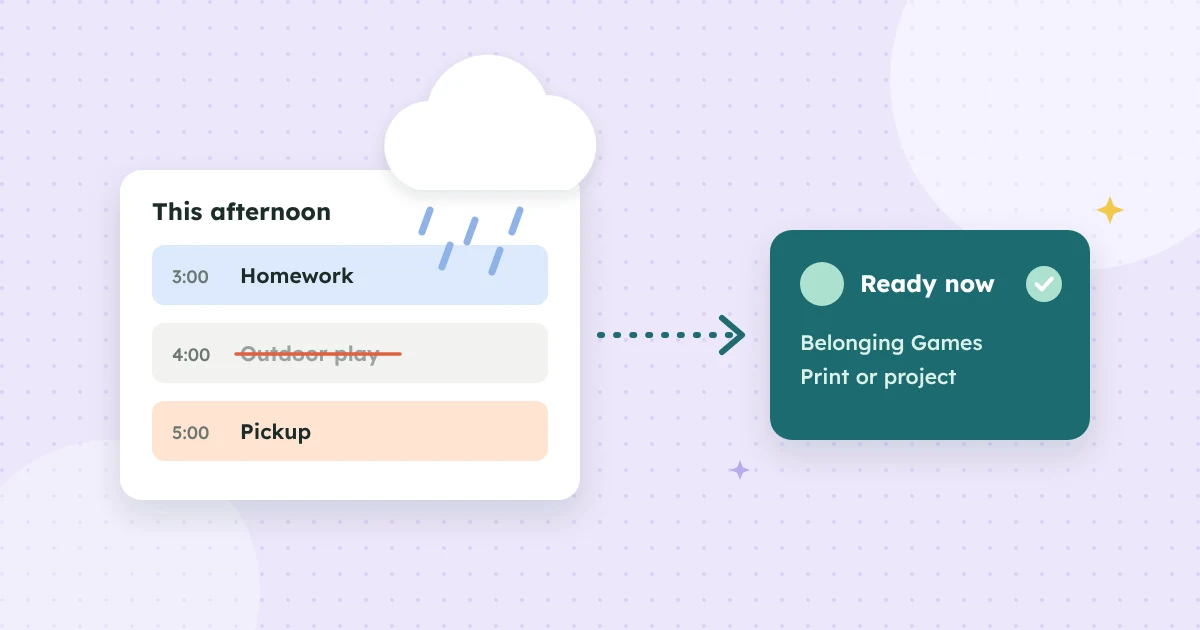
| 4:15–4:45 | Active play | Outdoor games, gym or a movement game indoors | Have a rainy-day indoor game ready |
| 4:45–5:25 | Enrichment block | Today's topic: hook, main activity, talk, close (below) | The block that needs fresh content every day |
| 5:25–6:00 | Choice time and pickup | Quiet choices: coloring, building, reading, finishing activity sheets | Pick activities any child can join or leave as pickups arrive |
If your program is funded by California's Expanded Learning Opportunities Program (ELO-P), the after-school hours count toward the program's nine-hour day. The California Department of Education requires a minimum of nine hours of combined instructional time and in-person expanded learning per instructional day for TK–6, and programs calculate those nine hours by adding instructional minutes, recess, meals and ELO-P program time. See our ELO-P enrichment guide for how enrichment fits that plan.
The enrichment block
How to run a 40-minute enrichment block
Forty minutes is long enough for something meaningful and short enough for most mixed K–5 groups. If your youngest children struggle with that, run 20 to 30 minutes, or split into two groups for the main activity. The same four steps work for any topic and any length:
1. Hook
About 5 minutes
Introduce the day's topic with a fact, a picture on the projector or a question. "Today is Frida Kahlo Day. Who has heard of her?"
2. Main activity
About 20 minutes
One shared activity the whole group does together: trivia, bingo, a drawing activity or a short challenge. Older children can read questions aloud or keep score.
3. Talk
About 10 minutes
Small groups discuss one or two questions about the topic, or finish a related activity sheet. Younger children can draw their answer instead of writing it.
4. Close
About 5 minutes
One word or one picture from each child who wants to share, and a quick recognition of effort, such as a certificate for taking part.
For mixed ages, keep one topic for everyone and change the task, not the theme: K–2 color, draw or find pictures; grades 3–5 read, write or lead a round. Our no-prep enrichment ideas are sorted by what the room has, from nothing at all to a projector.
Sample week
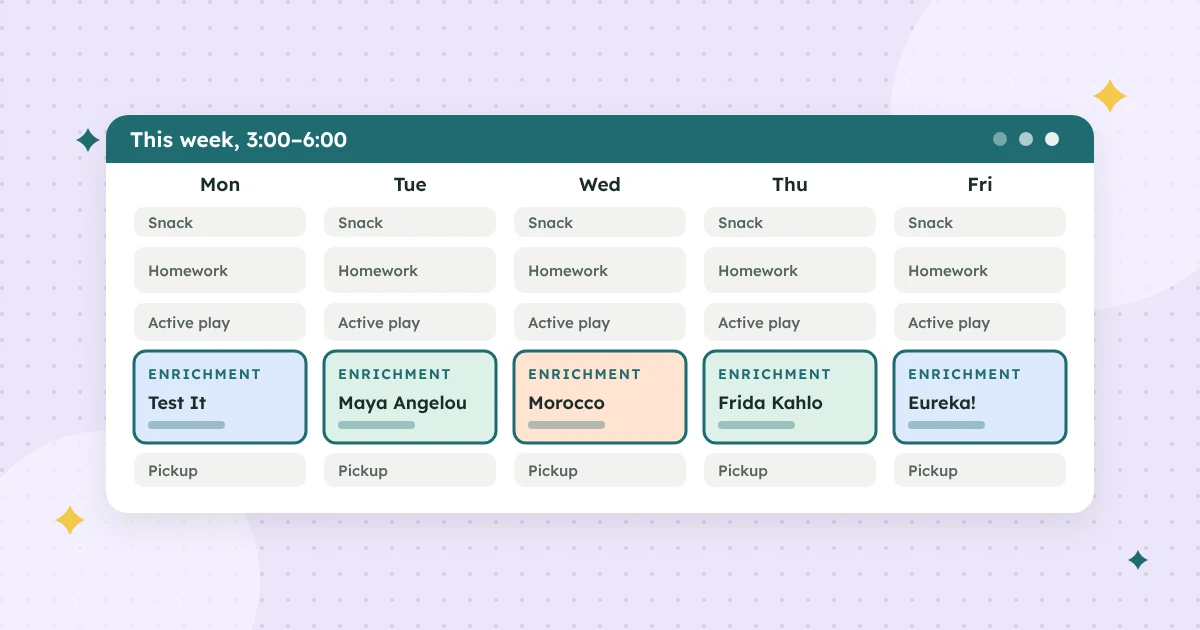
A sample week of after-school enrichment (November 16–20, 2026)
This week uses real events from the Belonging Games calendar, one per day, mixing STEM, SEL and cultural themes. Some events mark official observances, such as Morocco's Independence Day on November 18. Others are theme days the calendar uses to explore a person or an idea, such as Frida Kahlo Day; they are not her birthday or an international observance. Each day offers 1–3 events, so staff can pick the one that fits their group.
Monday, Nov 16: Test It Day
STEM · theme day
A day for testing things instead of just believing them: critical thinking that carries over into media literacy and friendships. Run: projector Trivia, then Bingo. Also that day: Mother Teresa Day, Open-Hearted Day.
Tuesday, Nov 17: Maya Angelou Day
SEL · theme day
The poet and civil rights leader who said people never forget how you made them feel; a day about kindness in action. Run: LoopTalk in small groups. Also that day: Oops Science Day, Student Power Day.
Wednesday, Nov 18: Morocco's Free Day
Cultural · Morocco's Independence Day
Morocco celebrates its Independence Day on November 18. A chance to explore Morocco's Arabic and Amazigh (Berber) heritage and the languages spoken there, including Arabic, Tamazight and French. Run: projector Facts, then How to Draw. Also that day: Latvia Free Day, Oman's Big Day.
Thursday, Nov 19: Frida Kahlo Day
SEL · theme day
Self-expression: the Mexican artist painted her real life rather than what was expected. Run: How to Draw, then Coloring. Also that day: Brothers and Boys Day, Monaco Royal Day.
Friday, Nov 20: Eureka Day
STEM · theme day
The "aha!" moment, named for Archimedes in his bathtub: noticing and trusting good ideas. Run: Trivia/Facts sheet in pairs, then certificates. Also that day: Kids' Rights Day (the UN's World Children's Day), Mexico's Revolution Day.
Two habits make a week like this work. Rotate themes so no one type of activity dominates, and keep the activity formats familiar, so children spend their attention on the topic rather than on learning new rules. When a cultural event is on the calendar, invite children who know the tradition to share, but never ask one child to speak for a culture; our belonging activities guide has more on this.
Template
A weekly enrichment plan you can print
Download the one-page weekly plan (PDF): the sample day and the sample week on page 1, and a blank week to fill in on page 2. The blank version looks like this:
| Day | Topic or event | Main activity | Print or project | Who leads | Backup if plans change |
|---|---|---|---|---|---|
| Monday | |||||
| Tuesday | |||||
| Wednesday | |||||
| Thursday | |||||
| Friday |
If you plan by hand, fill it in on Thursday or Friday for the week ahead. The backup column is the one most plans skip, and the one that saves the afternoon when something changes. A plan is ready when someone who has never seen it could run Monday's block after five minutes with the page in hand. That is the five-minute test we use for any enrichment resource.
Calendar delivery
How educators can receive enrichment through their calendar
For teams already using Google or Outlook Calendar, the calendar is a natural home for the daily plan: no binder to find and no shared drive to search. There are two ways to fill it.
| Step | Planning manually | Using Belonging Games |
|---|---|---|
| Choose topics | Select next week's topics | Review the 1–3 curated events each day |
| Get materials | Find and prepare activities | Open ready-to-run materials on the event page |
| Share with staff | Add each activity to a shared calendar | Events arrive in the calendar the team already uses |
| When plans change | Prepare backup activities | Choose another event that day or another activity in the same event |
Planning manually works with any calendar: add each day's enrichment block as an event, with the topic, the activity and a link to the materials in the description. Someone has to choose, prepare and post every activity, every week.
With Belonging Games, a program subscribes once and the events appear in the team's calendar every day. This is the text of the calendar entry for Test It Day on November 16, as sent to Google and Outlook (each lays it out in its own style):
| What staff see | In the calendar entry |
|---|---|
| Title | Test It Day - Belonging Games |
| Link | Open the activities for this event: belonginggames.com/event/test-it-day-2026 |
| About the day | This is a day for testing things instead of just believing them, and even tiny tests count |
| Ready to run (12 files) | Educator guide · 7 printables: Bingo, Coloring, Word Search, I-Spy, LoopTalk, Trivia/Facts, How to Draw · 3 projector activities: Trivia, Facts, Bingo · Certificate of achievement |
| Also today | Mother Teresa Day, Open-Hearted Day (see your calendar). Choose the event that fits your group |
A staff member opens the link, prints or projects what they need and runs the block. The first time they download, they verify their work email once on the event page; there is no password.
What Belonging Games is. Belonging Games is a daily, plug-and-play enrichment service for elementary after-school programs. Each day, educators receive 1–3 curated events across cultural, SEL and STEM themes through their existing Google or Outlook Calendar. Every event includes complete, ready-to-run activities their own staff can lead without planning or preparing from scratch. An Enrilo product.
See how daily enrichment would work in your program: book a demo. Still researching? Browse the live calendar for any week, or see pricing and the 30-day pilot.
When plans change
What to do when the schedule changes
A daily plan is tested on the days it cannot run as written: a staff call-out, a cancelled club, rain during active play or homework finishing early. Keep the structure and swap the content. Move active play indoors with a movement game, bring the enrichment block forward, or run a second event from the same day. Our guide to when the after-school plan falls through covers the first ten minutes, and enrichment for substitute and new staff covers what to hand someone who has never met the group.
Related: After-school enrichment programs compared · What is plug-and-play enrichment? · No-prep enrichment ideas
FAQ
Questions
How long should the enrichment block be in an after-school program?
For a mixed K–5 group, 30 to 45 minutes often works: long enough for an introduction, one shared activity and a short discussion. Kindergarten and first grade may do better with 20 to 30 minutes, or with the main activity split into two shorter parts.
How much physical activity should an after-school schedule include?
The National AfterSchool Association's HEPA 2.0 standards set 10 minutes for a one-hour program, rising to 30 minutes for a three-hour program, with at least half of that time moderate to vigorous. Check your state's or funder's requirements too.
How do you plan enrichment for mixed ages, kindergarten through fifth grade?
Keep one topic for the whole group and vary the task. Younger children color, draw or find pictures; older children read questions aloud, write answers or lead a round. A shared topic also gives siblings and friends of different ages something to talk about together.
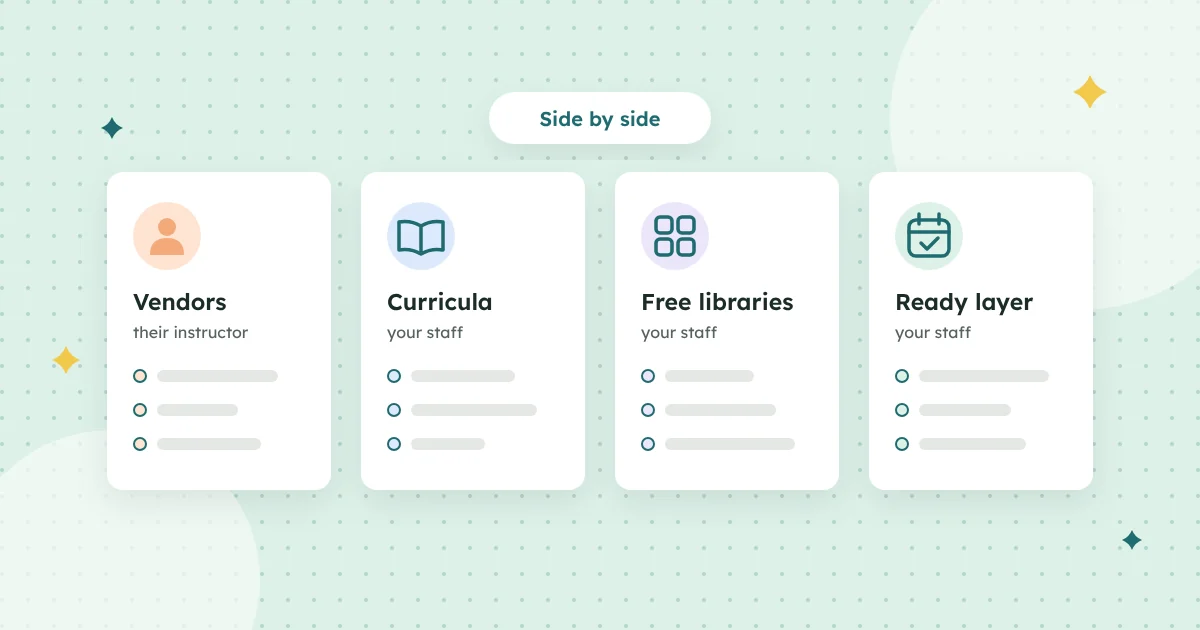
Is a daily enrichment plan the same as a curriculum?
No. A curriculum is a sequence of lessons that build on each other over weeks. A daily enrichment plan is a reliable time slot with a fresh topic each day. Many programs use both: a curriculum or club on set days, and a daily enrichment block for every afternoon.
Does ELO-P require a set daily schedule?
ELO-P requires a minimum of nine hours of combined instructional time and in-person expanded learning per instructional day for TK–6, counting instructional minutes, recess, meals and ELO-P time, plus at least 30 nonschooldays of nine hours. How those hours are scheduled is up to the local program plan. Confirm details with your district or the California Department of Education.
Can new or substitute staff follow this schedule?
The enrichment part, yes, if the plan is written down and the materials are ready before the day starts. A fixed rhythm helps: when the order of the afternoon stays the same, a substitute only has to learn today's topic. Ready-made activities do not replace your site's own safety procedures, supervision ratios, pickup rules or staff training; those still need a proper handoff.
Sources
Sources
- National AfterSchool Association, HEPA Standards 2.0 Self-Assessment Tool (physical activity time by program length; checked October 29, 2026) and NAA, HEPA standards
- California Department of Education, Expanded Learning Opportunities Program FAQs (nine-hour day and how it is calculated, 30 nonschooldays, TK–6; checked October 29, 2026)
- Belonging Games calendar (events and calendar entries for November 16–20, 2026, checked October 29, 2026)