Definition
What is after-school enrichment?
Three ideas run through most uses of the term.
- It is organized. Someone has planned the time with a purpose, even when children choose what to do within it.
- It complements the school day. It adds experiences children may not get in class, and it does not simply repeat the day's lessons.
- It serves the whole child. California law, for example, describes expanded learning as programs that develop pupils' "academic, social, emotional, and physical needs and interests."
Enrichment does not have to be loud, hands-on or led from the front of the room. Reading, listening to music, a quiet drawing project, a discussion and a child-run club can all be enrichment.
Examples
What are examples of after-school enrichment for K–5?
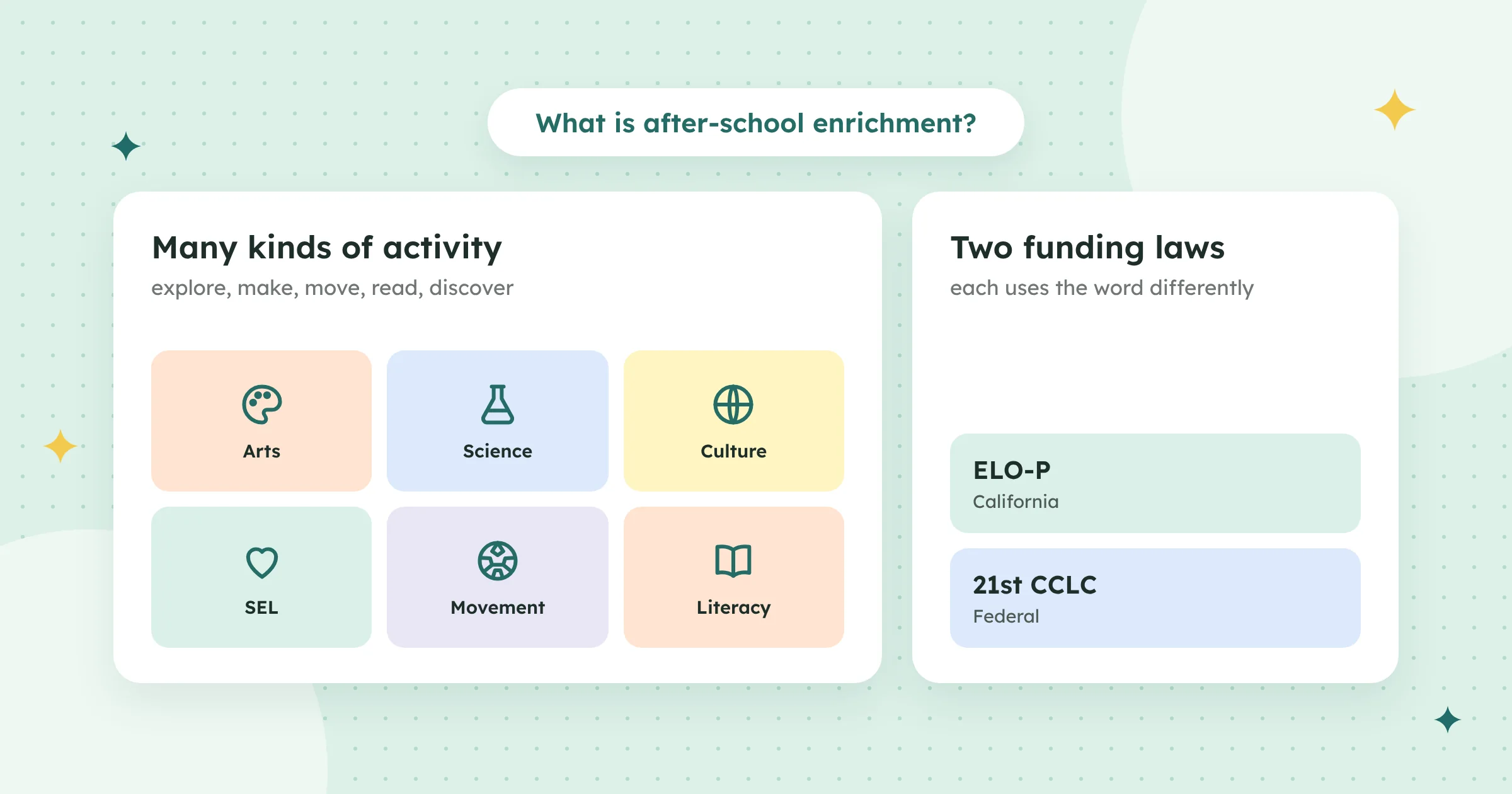
| Type | An example for a mixed-age K–5 group |
|---|---|
| Arts and music | Each child designs a flag for the group and explains three things on it |
| Science and engineering | Build a bridge from one sheet of paper that spans two books and holds as many pencils as possible |
| Cultural learning | Mark an occasion being celebrated that day: who celebrates it, where and why. Then try a greeting or a tradition connected to it |
| Social-emotional learning | Each child writes one specific compliment for a classmate. Sharing them aloud is voluntary |
| Movement and games | A cooperative group game that needs no equipment |
| Literacy | Read a short story aloud, then write the newspaper headline for what happened |
| Service and careers | Write thank-you notes to the people who work in the school, by name |
| A child-led project | Children choose a question they want to investigate, such as how tall a paper tower can stand, and plan how to find out |
The flag, the bridge and the compliment activity are described step by step in our twelve no-prep enrichment ideas. For activities built around belonging, see sense of belonging activities for after-school.
Overlapping terms
How is enrichment different from homework help, tutoring and free play?
These all belong in a good afternoon, and the lines between them depend on whose definition you use.
| Part of the afternoon | What children do | How it relates to enrichment |
|---|---|---|
| Homework help | Finish assignments from the school day, with an adult nearby | Usually treated as academic support. California's program framework lists it as a separate element beside enrichment |
| Tutoring | Get extra instruction in a school subject | It depends on the framework. Federal 21st CCLC law includes tutoring under "academic enrichment"; California's framework places it with homework help |
| More classroom instruction | Continue the school day's lessons | Most frameworks treat enrichment as a complement to instruction. California's ELO-P says expanded learning is not an extension of instructional time |
| Unstructured free play | Choose their own play, with supervision | Valuable in its own right, and ELO-P names play. Most programs treat it as its own part of the afternoon |
| Enrichment | Explore, make, move, read, discuss or discover, alone or together | Organized with a purpose, whoever leads it |
Under California's expanded learning framework, the term covers before-school, after-school, summer and intersession programs. Enrichment is one kind of activity within those programs.
Quality
What makes an after-school enrichment activity meaningful?
California's Quality Standards for Expanded Learning describe quality across a whole program: its activities, its staff and its participants. They call for "active, meaningful and engaging learning methods that promote collaboration and expand student horizons," and they also emphasize youth voice and leadership.
Drawing on those standards, here are four useful questions educators can ask when choosing or reviewing an activity. They are practical considerations, not official requirements that every activity must satisfy. The standards themselves say they are not intended to serve as a compliance tool.
- Are children engaged in it? Making, building, discussing, reading, listening closely and reflecting all count.
- Is there something to discover? A fact, a skill, a place, a person, a way of doing things.
- Does the activity create opportunities for connection, collaboration or independent exploration?
- Is there an educational or developmental purpose, with appropriate adult support?
An activity does not have to be elaborate or noisy to be meaningful. A child absorbed in a drawing is engaged. So is a group counting to twenty one voice at a time, practising how to listen and leave space.
Evidence
Does after-school enrichment make a difference?
A widely cited review is a 2010 meta-analysis by Durlak, Weissberg and Pachan of after-school programs that set out to build personal and social skills. Compared with control groups, participants showed gains in how they saw themselves, in bonding to school, in positive social behavior, and in school grades and achievement, and fewer problem behaviors. The authors report that four practices, which they called sequenced, active, focused and explicit, were linked to several of those results.
Two cautions. The review covers programs that aimed at personal and social skills, not every kind of enrichment. And it says nothing about any particular product, including ours.
Families
Do families want after-school programs?
This is a different question from whether programs work, and a different kind of evidence. In the 2025 America After 3PM survey of more than 30,000 parents, the Afterschool Alliance reports that parents of nearly 30 million children want after-school programs, and that more than 3 in 4 of those children are not in one. The survey measures demand and access, not educational results.
In practice
How do programs provide enrichment?
Programs get their enrichment in four main ways, and many combine them: instructors from an outside provider, a curriculum or kit their own staff teach, a library of activities staff choose from, or a service that sends prepared activities for each day. Children's own clubs and projects sit alongside all four. After-school enrichment programs compared sets twelve named options side by side, and best no-prep after-school activities sorts nine sources by how ready they are to use.
Disclosure and one example. Belonging Games is our product, made by Enrilo. It is a daily, plug-and-play enrichment service for elementary after-school programs. Each day, educators receive 1–3 curated events across cultural, SEL and STEM themes through their existing Google or Outlook Calendar. Every event includes complete, ready-to-run activities their own staff can lead without planning or preparing from scratch. It is one way to provide enrichment, and it does not replace tutoring, homework help or a sequenced curriculum.
ELO-P
What does ELO-P recognize as enrichment?
California's Expanded Learning Opportunities Program is set out in Education Code Section 46120. The California Department of Education describes it as funding for after-school and summer school enrichment programs for transitional kindergarten through grade 6.
The statute says what the time is for. "Expanded learning opportunities" does not mean an extension of instructional time. It means opportunities to engage pupils in enrichment, play, nutrition and other developmentally appropriate activities. Section 8482.1 adds that programs should offer "hands-on, engaging learning experiences" and should "complement, but do not replicate" learning in the regular school day.
Section 46120 also requires programs to follow parts of Section 8482.3, the law for California's After School Education and Safety program. That section requires two elements in every program:
- An educational and literacy element, in which tutoring or homework assistance is provided in language arts, mathematics, history and social science, computer training, or science.
- An educational enrichment element that "may include, but need not be limited to, fine arts, career technical education, recreation, physical fitness, and prevention activities."
So under this California program framework, homework help and tutoring sit beside enrichment as a separate element. That is how this program is structured; it is not a universal definition of enrichment. The enrichment list is open-ended: cultural and STEM activities are not named, and the words "need not be limited to" leave room for them. The section sets no split of time between the two elements.
For hours, days and staffing, see our guide to ELO-P enrichment.
21st CCLC
What does 21st CCLC recognize as enrichment?
The federal program is Title IV, Part B of the Elementary and Secondary Education Act. It uses the word "enrichment" mainly for the academic side.
The statute's first purpose is to provide opportunities for "academic enrichment," and it includes tutorial services in that phrase. Its second purpose is to offer "a broad array of additional services, programs, and activities" such as youth development, arts, music, physical fitness, technology education, mathematics and science, designed to "reinforce and complement the regular academic program."
The law then lists fourteen kinds of authorized activities. Among them:
- academic enrichment learning programs, mentoring, remedial education and tutoring
- well-rounded education activities
- literacy education, including financial and environmental literacy
- programs that support a healthy and active lifestyle, including nutrition education and structured physical activity
- cultural programs
- technology education
- programs that build skills in science, technology, engineering and mathematics, including computer science
- drug and violence prevention and counseling programs
The federal statute sets no daily hours and no split between academic and other activities. Each state runs its own competition, and a site is held to its approved application. See our guide to 21st CCLC enrichment.
Side by side
Which activities do ELO-P and 21st CCLC explicitly recognize?
| Activity | ELO-P (California) | 21st CCLC (federal) |
|---|---|---|
| Fine arts and music | Named in the enrichment element | Arts and music are named in the program's purposes |
| Science and STEM | Science is named in the academic support element. It is not named in the enrichment element, whose list is open-ended | Named as an authorized activity |
| Cultural programs | Not named; the list is open-ended | Named as an authorized activity |
| Physical activity and recreation | Named in the enrichment element | Named as an authorized activity |
| Social and emotional development | Part of the definition of expanded learning | Youth development is named in the program's purposes |
| Homework help and tutoring | Required, as a separate element | Tutoring is authorized, under academic enrichment |
| Play | Named in the definition | Not named in the sections we read; structured physical activity is |
| Extending classroom instruction | Excluded by the definition | Activities must reinforce and complement the school program |
This table shows what each law names. It does not show what a particular program may spend money on. Some enrichment expenses may be allowable under ELO-P or 21st CCLC, depending on the grant, the approved program plan and local procurement rules. Confirm with your district or grant administrator before you plan around it.
FAQ
Questions
Is homework help enrichment?
It depends on the framework. California's program framework treats tutoring and homework assistance as a separate required element next to the enrichment element. The federal 21st CCLC law lists tutoring under academic enrichment. Many programs simply call it academic support.
Does enrichment have to be led by an adult?
No. Children can run a club, pursue their own project or read on their own within a supervised program, and that can be enrichment. Adults still plan the time, provide materials and support, and supervise.
Is free play enrichment?
Play matters, and ELO-P names it among the things expanded learning time is for. Most programs treat unstructured free play as its own part of the afternoon, alongside organized enrichment.
Is enrichment the same as expanded learning?
No. Under California's expanded learning framework, the term covers before-school, after-school, summer and intersession programs. Enrichment is one kind of activity within those programs, alongside homework help, meals and play.
What does ELO-P recognize as enrichment?
The law names fine arts, career technical education, recreation, physical fitness and prevention activities, and says the list is not limited to those. Programs should offer hands-on, engaging experiences that complement the school day without repeating it.
What does 21st CCLC recognize as enrichment?
The federal law authorizes fourteen kinds of activities, including academic enrichment and tutoring, cultural programs, STEM programs, literacy education, healthy and active lifestyle programs and well-rounded education activities. A site's approved application and its state's rules decide what it actually runs.
How much of the afternoon should be enrichment?
Neither law sets a number of minutes for enrichment activities. That is not the same as having no time rules: ELO-P separately sets how long the program day must be and how many non-school days a program must run, and each state sets its own hours for 21st CCLC sites. See ELO-P enrichment for the California rules. Our sample weekly schedule shows one way to fit a 40-minute enrichment block into a 3:00 to 6:00 afternoon.
Sources
Sources
- California Education Code Section 46120: the definition of expanded learning opportunities in subdivision (g), and the requirement in subdivision (b)(5) to comply with parts of Section 8482.3 (2025 California Code, as amended effective October 13, 2025; checked November 27, 2026)
- California Education Code Section 8482.1: the definition of expanded learning (FindLaw, current as of January 1, 2026; checked November 27, 2026)
- California Education Code Section 8482.3: the educational and literacy element and the educational enrichment element in subdivision (c) (FindLaw, current as of January 1, 2026; checked November 27, 2026)
- California Department of Education, Expanded Learning Opportunities Program FAQs: program description and grades (checked November 27, 2026)
- Quality Standards for Expanded Learning in California: Active and Engaged Learning; Youth Voice and Leadership; the statement that the standards are not a compliance tool (California Department of Education and California AfterSchool Network, September 2014; checked November 27, 2026)
- 20 U.S.C. 7171, Purpose; definitions: the three purposes and the definition of a community learning center (checked November 27, 2026)
- 20 U.S.C. 7175, Local activities: the fourteen authorized activities (checked November 27, 2026)
- Durlak, J. A., Weissberg, R. P., & Pachan, M. (2010). A meta-analysis of after-school programs that seek to promote personal and social skills in children and adolescents. American Journal of Community Psychology, 45(3), 294–309.
- Afterschool Alliance, Lost Opportunity: Afterschool in Demand, But Out of Reach for Many (America After 3PM, October 15, 2025; checked November 27, 2026)
Statutes and agency guidance change. Confirm current rules with the California Department of Education, your state 21st CCLC coordinator and your own grant administrator.